
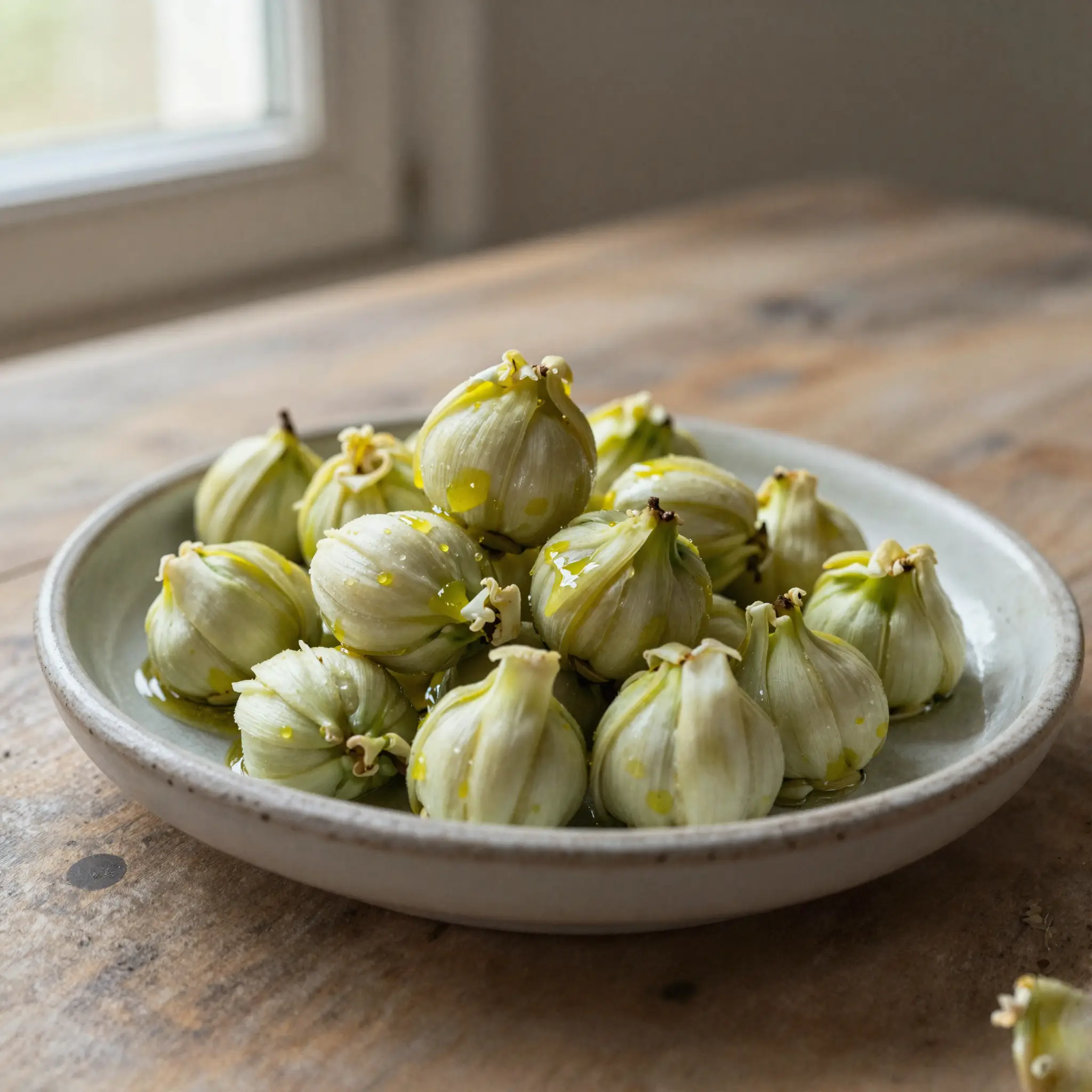
Jonjoli (Georgian pickled bladdernut buds)
Jonjoli (Georgian pickled bladdernut flower buds)
vegetable-ferment-pickle
Facts
| Category | Vegetable |
|---|---|
| Product family | Fermented Flower Bud/Shoot Pickle |
| Origin | 🇬🇪 Georgia |
Safety
- Same core anaerobic/salinity-floor logic as other brined vegetable ferments in this program. Documented risk factor — anything left above the brine line is explicitly flagged in the reviewed source as "where trouble starts," i.e. exposed buds risk surface mould/spoilage, and, in a fully anaerobic low-acid pocket before acidification, a theoretical Clostridium botulinum concern applies as it would to any low-acid vegetable brine ferment. Safe-practice guidance:
(a) use non-iodized salt (explicitly noted in the reviewed source, consistent with general brined-vegetable practice — iodized salt can inhibit fermentation and cloud brine);
(b) keep all buds fully submerged below the brine at every stage, including the initial dry-salt rest;
(c) target pH ≤4.6 as the general endpoint for this class of ferment (not independently confirmed for jonjoli specifically);
(d) refrigerate after fermentation and keep submerged in brine for extended storage;
(e) do not seal into a shelf-stable, non-refrigerated low-acid state without a validated canning process.
Method
Jonjoli (Georgian Fermented Bladdernut Flower Buds)
- Unopened bladdernut (Staphylea colchica) flower buds, harvested before flowering, tough stems removed — quantity per batch size (no standard reference weight identified)
- Non-iodized salt — for the initial dry-salt step (illustrative reference cited in sources: ~25 g salt per 1 kg of buds) — SAFETY CONTROL, see linked Variant
- Additional salt + water — to make the fermentation brine
- For serving (not part of the ferment itself, non-safety): thinly sliced red onion, sunflower oil, optional cilantro
- 1
Step 1
Harvest buds while still tightly closed, before flowering.
- 2
Step 2
Clean buds and remove tough stems.
- 3
Step 3
Dry-salt the buds (toss with the measured salt) and leave covered for roughly 8–12 hours to draw out moisture.
- 4
Step 4
Squeeze/drain the buds and pack tightly into a clean jar.
- 5
Step 5
Cover with a salt brine at target strength.
- 6
Step 6
Weight the buds so all solids stay fully submerged below the brine line.
- 7
Step 7
Cover with a breathable lid; ferment at ambient-to-cool room temperature.
- 8
Step 8
Taste from around day 5 for clean sourness and aroma; continue to roughly 10–14 days, often faster in a warm kitchen.
- 9
Step 9
Once ready, chill and let mature a few further days in the refrigerator.
- 10
Step 10
To serve: squeeze out excess brine, fluff the buds, and dress with thinly sliced red onion and sunflower oil.
Frequently asked questions
- What is Jonjoli (Georgian pickled bladdernut buds)?
- vegetable-ferment-pickle
- Where does Jonjoli (Georgian pickled bladdernut buds) come from?
- Jonjoli (Georgian pickled bladdernut buds) is traditionally made in Georgia.
- Is Jonjoli (Georgian pickled bladdernut buds) safe to make at home?
- Same core anaerobic/salinity-floor logic as other brined vegetable ferments in this program. Documented risk factor — anything left above the brine line is explicitly flagged in the reviewed source as "where trouble starts," i.e. exposed buds risk surface mould/spoilage, and, in a fully anaerobic low-acid pocket before acidification, a theoretical Clostridium botulinum concern applies as it would to any low-acid vegetable brine ferment. Safe-practice guidance:
(a) use non-iodized salt (explicitly noted in the reviewed source, consistent with general brined-vegetable practice — iodized salt can inhibit fermentation and cloud brine);
(b) keep all buds fully submerged below the brine at every stage, including the initial dry-salt rest;
(c) target pH ≤4.6 as the general endpoint for this class of ferment (not independently confirmed for jonjoli specifically);
(d) refrigerate after fermentation and keep submerged in brine for extended storage;
(e) do not seal into a shelf-stable, non-refrigerated low-acid state without a validated canning process.
Community results
No community results published for this ferment yet.