
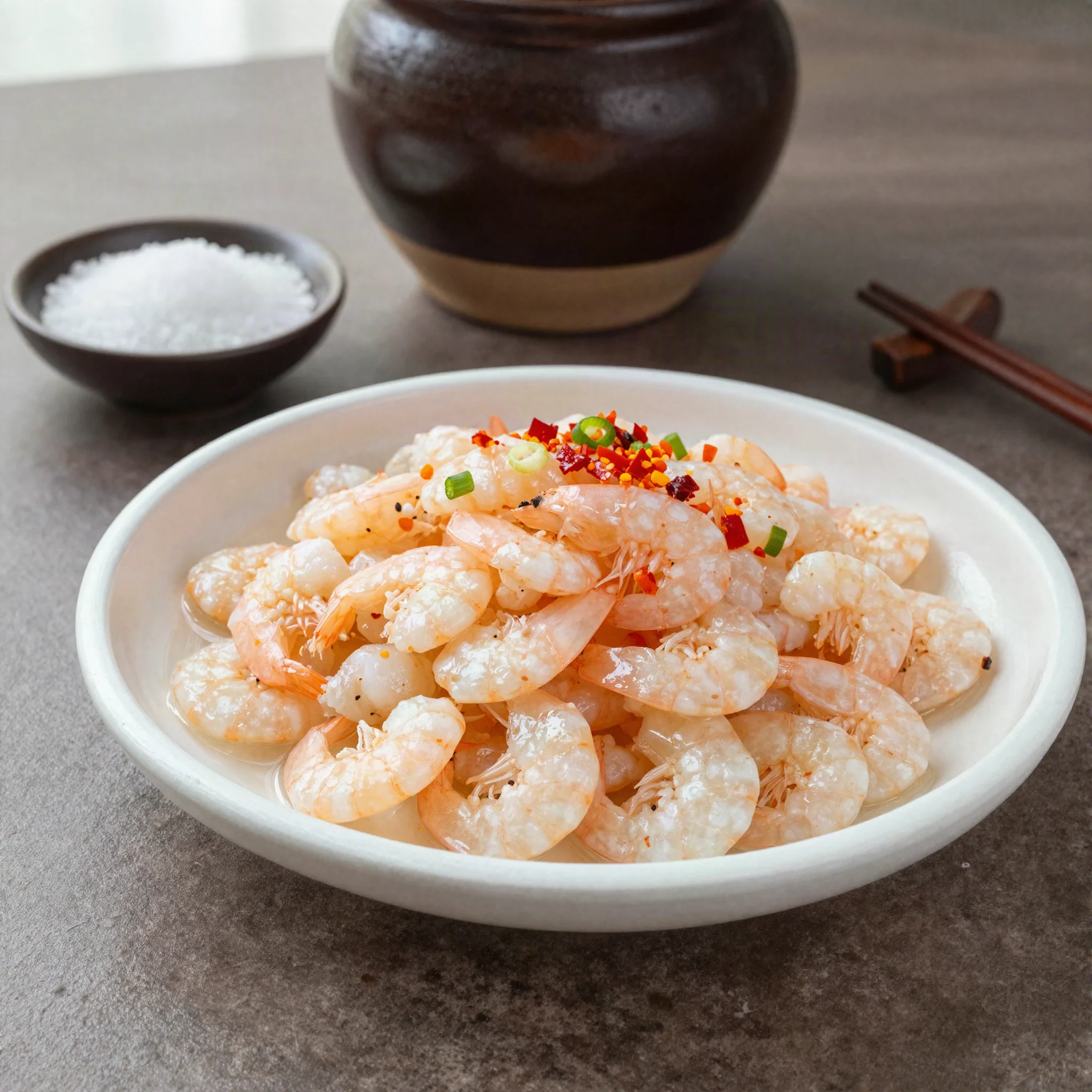
Jeotgal (Korean salted-fermented seafood)
Condiment/paste
Facts
| Category | Meat / Fish |
|---|---|
| Product family | Korean Salted-Fermented Seafood |
| Origin | 🇰🇷 South Korea |
| Key microorganisms | halophilic-other |
Safety
- Fermented seafood is, alongside fermented meat, the highest-hazard class, and jeotgal's safety rests on salt as the primary hurdle — not on fermentation "outcompeting" spoilage. Documented risk factors:
(a) Histamine / scombroid poisoning — the defining hazard of fermented fish. Bacteria decarboxylate free histidine (abundant in anchovy and other dark-muscle/scombroid-type fish) into histamine during fermentation and storage; histamine is heat-stable and is NOT destroyed by cooking, so it cannot be corrected downstream. The only effective control is seafood that is genuinely fresh and continuously cold-handled from catch to salting.
(b) Clostridium botulinum type E — the fish-associated, cold-tolerant type; a salted, tightly packed, anaerobic seafood mass is precisely its habitat, and the salt load is what suppresses it.
(c) Salt is the primary hurdle — an under-salted jeotgal is not a milder version of the product, it is a product with its principal control removed.
(d) Parasites — anisakid nematodes and other parasites occur in marine fish and squid; fermentation is not a reliable inactivation step, whereas regulated freezing regimes are the documented control.
(e) Listeria monocytogenes and Salmonella — jeotgal is ready-to-eat with no cooking step of its own.
(f) Fish/shellfish allergen — a major regulated allergen, and a hidden allergen in kimchi and other dishes seasoned with jeotgal where no fish is visible on the plate.
(g) Spoilage vs. ferment — progressive softening, a strong salty-savoury aroma and liquid separation are expected; putrid or ammoniacal off-odour, gassing, discolouration, sliminess or surface mould are discard indicators. Safe-practice guidance: prefer commercially produced jeotgal from a food-safe supply chain over home-fermenting seafood; if produced traditionally, use only fresh, continuously cold-handled seafood; do not reduce the traditional salt load; keep the mass packed and covered by its own brine; refrigerate after opening; treat as ready-to-eat; and declare the fish/shellfish allergen wherever jeotgal is used as a seasoning. Numerics: no salt percentage, histamine ppm, pH, temperature or duration figure is asserted here — these are regulated, authority-grade values; every such figure is (illustrative) or not established.
Method
Jeotgal (Korean salted-fermented seafood)
- Small whole fish or shellfish — anchovy (myeolchi), tiny shrimp (saeu), squid, oyster or clam, depending on the type — ~1 kg (illustrative). Freshness at the point of salting is a SAFETY CONTROL.
- Salt — SAFETY CONTROL — ~300 g (illustrative; roughly 3 parts seafood to 1 part salt by weight, the same family convention). The salt is the primary hurdle of the whole process and must not be reduced.
- (post-fermentation seasoning, type-dependent, not part of the ferment) gochugaru, garlic, scallion, sesame oil, sesame seed — to taste
- Non-reactive fermentation vessel with a close cover; a weight or press to keep the mass submerged
- 1
Step 1
Start from genuinely fresh, continuously cold-handled seafood; rinse and drain. Gut/clean as the type requires; the smallest fish and shrimp are left whole.
- 2
Step 2
Mix the seafood thoroughly with a large proportion of salt so every surface is coated (even distribution is itself a control point). (Salt ratio: not established.)
- 3
Step 3
Pack tightly into the vessel, pressing out air pockets, so the mass sits below its own liquid as brine draws out; weight it if needed.
- 4
Step 4
Cover and hold at ambient-to-cool temperature for the fermentation/autolysis period. The flesh softens progressively and a savoury brine separates. (Temperature and duration: not established.)
- 5
Step 5
Fork in the road — two products: either
(a) keep the chunky salted-seafood condiment as-is, or
(b) strain/press off the liquid and mature it further to give aekjeot, the liquid form. - 6
Step 6
(Type-dependent, after fermentation only) dress a portion with gochugaru, garlic, scallion and sesame for table use. This is seasoning, not a second ferment.
- 7
Step 7
Store refrigerated and treat as ready-to-eat. Use in small quantities as a condiment, or as the seasoning component of kimchi — kimchi itself has its own entry and is not reproduced or re-specified here.
Frequently asked questions
- What is Jeotgal (Korean salted-fermented seafood)?
- Condiment/paste
- Which microorganisms ferment Jeotgal (Korean salted-fermented seafood)?
- Jeotgal (Korean salted-fermented seafood) is primarily driven by halophilic-other.
- Where does Jeotgal (Korean salted-fermented seafood) come from?
- Jeotgal (Korean salted-fermented seafood) is traditionally made in South Korea.
- Is Jeotgal (Korean salted-fermented seafood) safe to make at home?
- Fermented seafood is, alongside fermented meat, the highest-hazard class, and jeotgal's safety rests on salt as the primary hurdle — not on fermentation "outcompeting" spoilage. Documented risk factors:
(a) Histamine / scombroid poisoning — the defining hazard of fermented fish. Bacteria decarboxylate free histidine (abundant in anchovy and other dark-muscle/scombroid-type fish) into histamine during fermentation and storage; histamine is heat-stable and is NOT destroyed by cooking, so it cannot be corrected downstream. The only effective control is seafood that is genuinely fresh and continuously cold-handled from catch to salting.
(b) Clostridium botulinum type E — the fish-associated, cold-tolerant type; a salted, tightly packed, anaerobic seafood mass is precisely its habitat, and the salt load is what suppresses it.
(c) Salt is the primary hurdle — an under-salted jeotgal is not a milder version of the product, it is a product with its principal control removed.
(d) Parasites — anisakid nematodes and other parasites occur in marine fish and squid; fermentation is not a reliable inactivation step, whereas regulated freezing regimes are the documented control.
(e) Listeria monocytogenes and Salmonella — jeotgal is ready-to-eat with no cooking step of its own.
(f) Fish/shellfish allergen — a major regulated allergen, and a hidden allergen in kimchi and other dishes seasoned with jeotgal where no fish is visible on the plate.
(g) Spoilage vs. ferment — progressive softening, a strong salty-savoury aroma and liquid separation are expected; putrid or ammoniacal off-odour, gassing, discolouration, sliminess or surface mould are discard indicators. Safe-practice guidance: prefer commercially produced jeotgal from a food-safe supply chain over home-fermenting seafood; if produced traditionally, use only fresh, continuously cold-handled seafood; do not reduce the traditional salt load; keep the mass packed and covered by its own brine; refrigerate after opening; treat as ready-to-eat; and declare the fish/shellfish allergen wherever jeotgal is used as a seasoning. Numerics: no salt percentage, histamine ppm, pH, temperature or duration figure is asserted here — these are regulated, authority-grade values; every such figure is (illustrative) or not established.
Community results
No community results published for this ferment yet.