
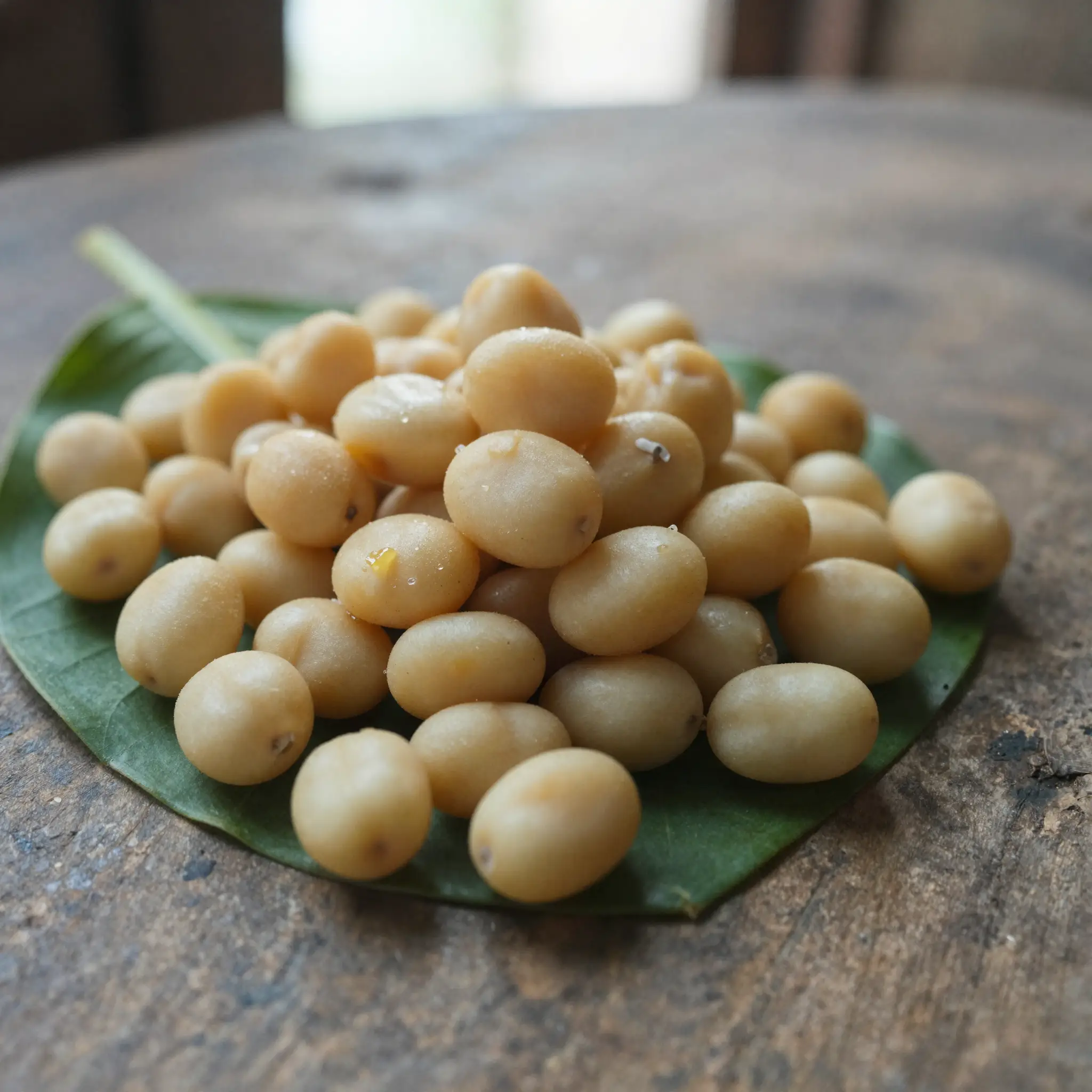
Hawaijar (Manipuri fermented sticky soybean)
Legume ferment/condiment
Facts
| Category | Grain / Legume |
|---|---|
| Product family | Northeast Indian Bacillus Fermented Soybean |
| Origin | 🇮🇳 India |
| Key microorganisms | bacillus-spp |
Safety
- Documented considerations:
(a) adequate cooking of the raw soybeans before fermenting is a defining safety step — thorough cooking softens the bean, selects for spore-forming Bacillus by killing non-spore-forming competing organisms, and addresses the general anti-nutrient/lectin content of raw soybeans;
(b) as an alkaline fermentation, pH rises rather than falls, so lactic-family "drop the pH" safety modeling does not apply; safety instead rests on the initial cook's competitor-killing effect, B. subtilis's competitive dominance, and a short, well-controlled fermentation window;
(c) the honest healthy-stringy vs. spoilage distinction: properly fermented hawaijar has a sticky/stringy texture and a pungent-but-characteristic aroma — a genuinely putrid or foul odor, or visible non-Bacillus mold contamination/discoloration, indicates spoilage and the batch should be discarded, not eaten; described honestly and qualitatively;
(d) soy allergen note: hawaijar is soybean-based and is not appropriate for individuals with a soy allergy;
(e) potable water must be used throughout, for soaking and cooking the beans. Safe-practice guidance: cook raw soybeans thoroughly before fermenting; use clean equipment and potable water; ferment at a controlled, moderate warm temperature for a short window; confirm the characteristic sticky-stringy texture and pungent-but-not-putrid aroma as signs of a safely proceeding ferment; discard any batch showing foul/putrid odor or visible contaminant mold growth; incorporate hawaijar into further-cooked or pounded dishes per traditional practice rather than eating large quantities raw; disclose the soy allergen. No specific pathogen thresholds, pH figures, or ammonia-concentration numerics are asserted — any such figure is illustrative or not established.
Method
Hawaijar (Manipuri Fermented Sticky Soybean)
- Soybeans (whole or crushed, dried) — ~1 kg
- Water — sufficient for soaking and thorough cooking, potable
- Banana leaves or other regionally available leaves (or a clean covered container) — for wrapping, cleaned, per traditional practice
- 1
Step 1
Clean the dried soybeans, removing debris and any visibly discolored or damaged beans.
- 2
Step 2
Soak the soybeans in potable water until softened.
- 3
Step 3
Cook the soaked soybeans thoroughly until fully tender.
- 4
Step 4
Drain the cooked beans while still warm, keeping them whole or lightly crushing, per household preference.
- 5
Step 5
Wrap the beans in cleaned banana or other regional leaves, or place in a clean, covered container.
- 6
Step 6
Leave to ferment at ambient/warm temperature.
- 7
Step 7
Check periodically: naturally-occurring ambient Bacillus subtilis proteolyzes the beans, producing a sticky, stringy texture and pungent aroma (typically 2–4 days, illustrative, tradition- and household-variable).
- 8
Step 8
Once the characteristic sticky-stringy texture and pungent-but-not-putrid aroma develop, the hawaijar is ready.
- 9
Step 9
Incorporate into further-cooked or pounded dishes (e.g. eromba, singju) before serving.
Frequently asked questions
- What is Hawaijar (Manipuri fermented sticky soybean)?
- Legume ferment/condiment
- Which microorganisms ferment Hawaijar (Manipuri fermented sticky soybean)?
- Hawaijar (Manipuri fermented sticky soybean) is primarily driven by bacillus-spp.
- Where does Hawaijar (Manipuri fermented sticky soybean) come from?
- Hawaijar (Manipuri fermented sticky soybean) is traditionally made in India.
- Is Hawaijar (Manipuri fermented sticky soybean) safe to make at home?
- Documented considerations:
(a) adequate cooking of the raw soybeans before fermenting is a defining safety step — thorough cooking softens the bean, selects for spore-forming Bacillus by killing non-spore-forming competing organisms, and addresses the general anti-nutrient/lectin content of raw soybeans;
(b) as an alkaline fermentation, pH rises rather than falls, so lactic-family "drop the pH" safety modeling does not apply; safety instead rests on the initial cook's competitor-killing effect, B. subtilis's competitive dominance, and a short, well-controlled fermentation window;
(c) the honest healthy-stringy vs. spoilage distinction: properly fermented hawaijar has a sticky/stringy texture and a pungent-but-characteristic aroma — a genuinely putrid or foul odor, or visible non-Bacillus mold contamination/discoloration, indicates spoilage and the batch should be discarded, not eaten; described honestly and qualitatively;
(d) soy allergen note: hawaijar is soybean-based and is not appropriate for individuals with a soy allergy;
(e) potable water must be used throughout, for soaking and cooking the beans. Safe-practice guidance: cook raw soybeans thoroughly before fermenting; use clean equipment and potable water; ferment at a controlled, moderate warm temperature for a short window; confirm the characteristic sticky-stringy texture and pungent-but-not-putrid aroma as signs of a safely proceeding ferment; discard any batch showing foul/putrid odor or visible contaminant mold growth; incorporate hawaijar into further-cooked or pounded dishes per traditional practice rather than eating large quantities raw; disclose the soy allergen. No specific pathogen thresholds, pH figures, or ammonia-concentration numerics are asserted — any such figure is illustrative or not established.
Community results
No community results published for this ferment yet.