
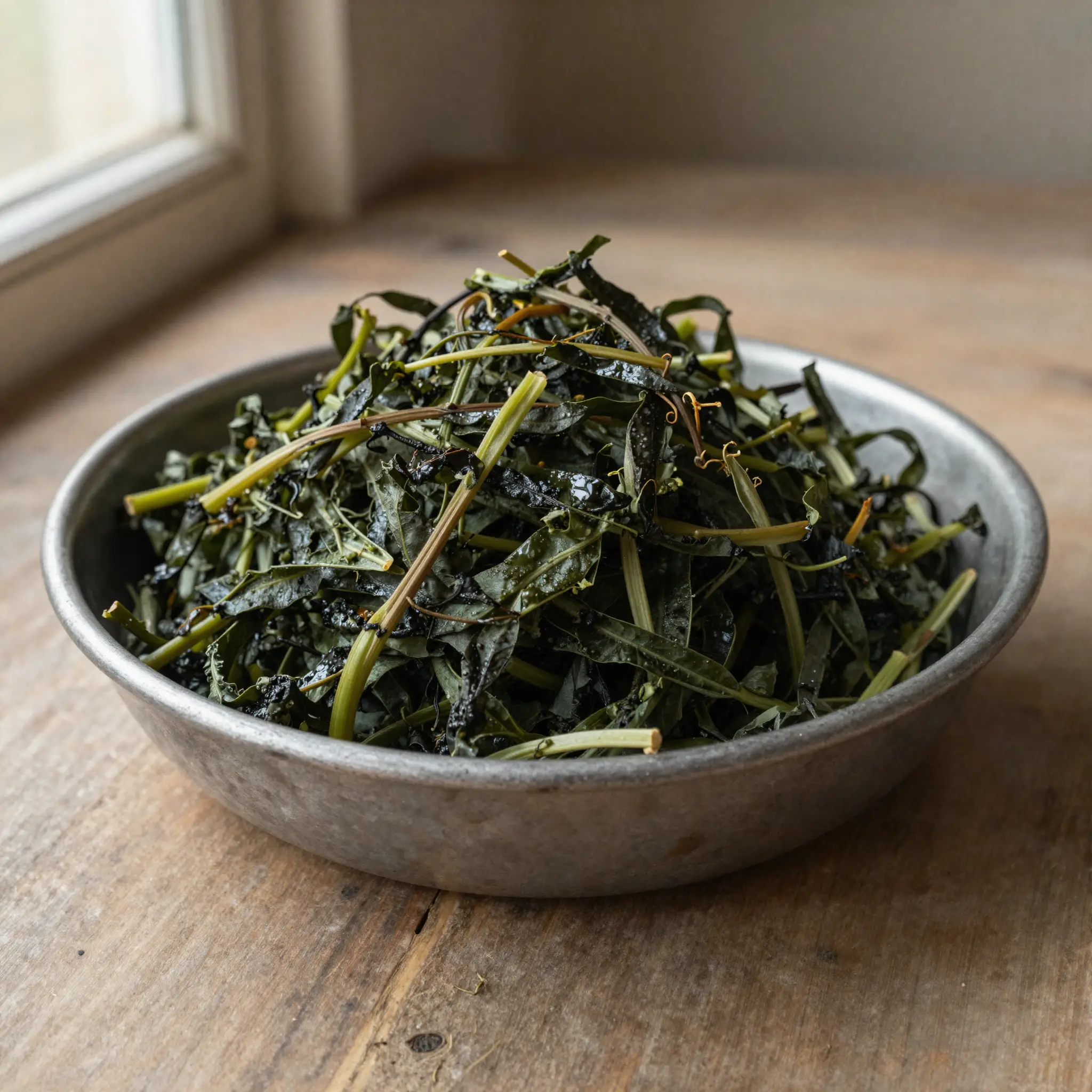
Gundruk (Nepali sun-dried fermented greens)
Gundruk (Nepali sun-dried fermented leafy greens)
vegetable-ferment-pickle
Facts
| Category | Vegetable |
|---|---|
| Product family | Himalayan Fermented Leafy-Green Preserve |
| Origin | 🇳🇵 Nepal |
Safety
- The safety-relevant literature specific to gundruk is thin relative to brine-based vegetable ferments — this is stated explicitly rather than backfilled with invented numbers. Two distinct safety-relevant mechanisms operate in sequence and must not be conflated:
(a) during the wet fermentation stage, because added salt is low or absent, adequate anaerobic packing/pressing (excluding air) and reaching sufficient acidification are the operative controls against spoilage organisms, analogous in principle to other low-salt lactic vegetable ferments;
(b) the sun-drying stage is itself the primary long-term preservation step for the finished product — thorough, even drying to a low final moisture content is what prevents mould/spoilage during storage, distinct from and additional to the acidity achieved during fermentation. Safe-practice guidance:
(i) keep the wilted leaf mass firmly packed/weighted and free of air pockets during the fermentation stage; (ii) ferment until distinctly sour before drying; (iii) dry thoroughly and evenly in the sun (turning/exposure sufficient to avoid damp pockets) before storage; (iv) discard any batch showing putrid odour, sliminess, or visible mould rather than off-white surface bloom consistent with normal LAB activity;
(v) store the dried product in a dry environment to prevent post-drying mould regrowth. Precise pH, salinity, and moisture-content thresholds for gundruk specifically are not established
Method
Gundruk (Nepali Sun-Dried Fermented Leafy Greens)
- Mustard greens and/or radish leaves (fresh, slightly mature) — ~1500 g
- Water — a small amount only, if needed to aid packing (traditionally minimal to none)
- Salt — traditionally little to no added salt (distinguishing feature vs. brine ferments) — SAFETY CONTROL, see linked Variant for the low-salt/anaerobic-packing risk logic
- 1
Step 1
Wash the leaves; wilt briefly in the sun for a few hours to soften.
- 2
Step 2
Pack the wilted leaves very tightly into a clean earthenware pot, bamboo container, or jar, pressing firmly to exclude air pockets.
- 3
Step 3
Weight the packed leaves (e.g. a clean stone or weighted lid) to maintain firm, airless packing throughout the ferment.
- 4
Step 4
Cover breathably; ferment at ambient temperature, checking periodically that the mass stays firmly packed and shows no putrid odour or mould.
- 5
Step 5
Ferment until distinctly sour, roughly several days to about a week (illustrative).
- 6
Step 6
Remove the fermented mass and spread it out to sun-dry, turning periodically for even drying, over several days until fully dehydrated.
- 7
Step 7
Store the dried gundruk in a dry container; rehydrate in water before cooking (typically simmered into a soup or sautéed side dish).
Frequently asked questions
- What is Gundruk (Nepali sun-dried fermented greens)?
- vegetable-ferment-pickle
- Where does Gundruk (Nepali sun-dried fermented greens) come from?
- Gundruk (Nepali sun-dried fermented greens) is traditionally made in Nepal.
- Is Gundruk (Nepali sun-dried fermented greens) safe to make at home?
- The safety-relevant literature specific to gundruk is thin relative to brine-based vegetable ferments — this is stated explicitly rather than backfilled with invented numbers. Two distinct safety-relevant mechanisms operate in sequence and must not be conflated:
(a) during the wet fermentation stage, because added salt is low or absent, adequate anaerobic packing/pressing (excluding air) and reaching sufficient acidification are the operative controls against spoilage organisms, analogous in principle to other low-salt lactic vegetable ferments;
(b) the sun-drying stage is itself the primary long-term preservation step for the finished product — thorough, even drying to a low final moisture content is what prevents mould/spoilage during storage, distinct from and additional to the acidity achieved during fermentation. Safe-practice guidance:
(i) keep the wilted leaf mass firmly packed/weighted and free of air pockets during the fermentation stage; (ii) ferment until distinctly sour before drying; (iii) dry thoroughly and evenly in the sun (turning/exposure sufficient to avoid damp pockets) before storage; (iv) discard any batch showing putrid odour, sliminess, or visible mould rather than off-white surface bloom consistent with normal LAB activity;
(v) store the dried product in a dry environment to prevent post-drying mould regrowth. Precise pH, salinity, and moisture-content thresholds for gundruk specifically are not established
Community results
No community results published for this ferment yet.