
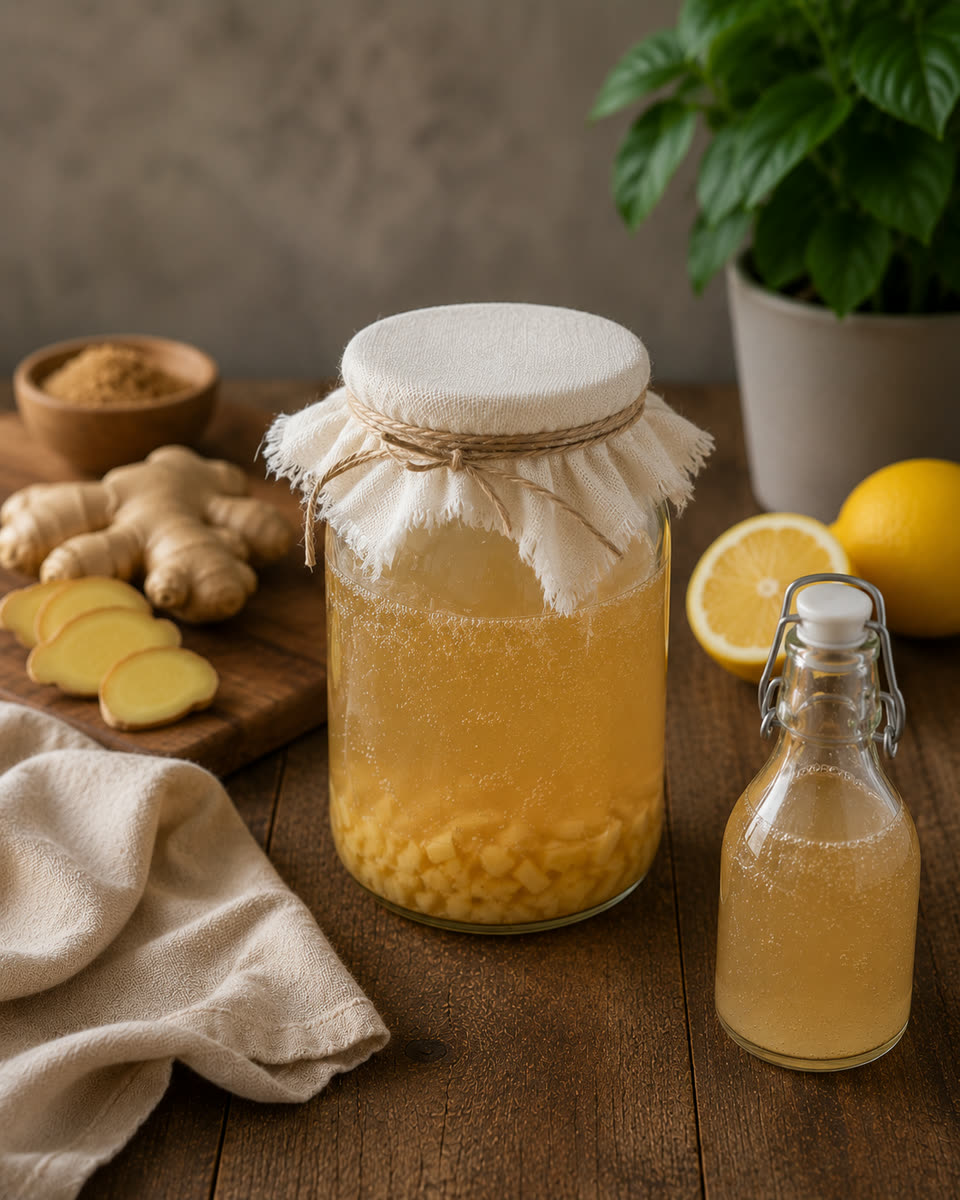
Traditional (wild-fermented) ginger beer
Ginger beer (traditional wild-fermented ginger-and-sugar-water beverage)
Beverage
Facts
| Category | Beverage |
|---|---|
| Product family | Fermented Root-and-Sugar-Water Beverage |
| Origin | 🇬🇧 United Kingdom |
| Key microorganisms | lactic-acid-bacteria, yeasts |
Safety
- Documented considerations (honest, beverage-appropriate, general-knowledge — our sources hold no safety literature specific to this ferment):
(a) the ginger bug is a spontaneously wild-cultivated starter, so visible fermentation activity (bubbling, sour-yeasty aroma) during its building phase is the primary indicator that the culture is developing safely rather than simply sitting as an inert sugar-ginger-water mixture;
(b) mould growth or a markedly putrid/off odour (as opposed to the expected sour-sweet, yeasty aroma) at either the ginger-bug-building stage or the final-beverage-fermentation stage signals spoilage — such batches should be discarded, not consumed;
(c) potable water must be used throughout, both for building the ginger bug and for the final beverage;
(d) over-carbonation / bottle-pressure (bottle-bomb) risk: as with water kefir and kombucha, if the final beverage is bottled for a sealed secondary fermentation and left too long or too warm, continued yeast activity can build substantial internal gas pressure, creating a genuine mechanical over-pressure/rupture hazard — this is, in fact, one of the most commonly and explicitly documented risks specifically associated with home-fermented ginger beer in general-knowledge home-fermentation sources (sometimes informally called a "ginger beer bottle bomb"), and this entry notes it honestly without asserting a specific fabricated pressure threshold or numeric time/temperature limit; general-knowledge practice manages this with pressure-tolerant (e.g. swing-top) bottles, periodic "burping," refrigerating promptly once carbonation is judged adequate, and some practitioners' use of plastic (rather than glass) bottles specifically so that firmness can be checked by hand-squeezing before opening — noted as a documented home-practice mitigation, not a food-safety-authority-issued standard;
(e) the mild alcohol content should be disclosed to consumers avoiding alcohol, per the same boundary-note discipline as kefir/kombucha/water kefir/jun. Safe-practice guidance: use clean equipment and potable water throughout; build and maintain the ginger bug with daily feeding until clearly active before using it; discard on any mould growth or clearly putrid off-odour at any stage; if bottling for secondary carbonation, use pressure-tolerant bottles, burp periodically, and refrigerate promptly; disclose the mild alcohol content where relevant. No specific pathogen thresholds, pH figures, bottle-pressure figures, or alcohol percentages are asserted — any such figure is illustrative or not established.
Method
Ginger Beer (Traditional Wild-Fermented Ginger-and-Sugar-Water Beverage)
- Stage 1 (building the "ginger bug" starter):
- Fresh ginger root, grated or finely chopped (unpeeled, per common home-fermentation practice, since the ginger's own skin/epiphytic microbiota is a documented contributor to the wild culture) — ~2 tbsp per feeding, illustrative
- Sugar (commonly cane sugar) — ~2 tbsp per feeding, illustrative
- Water — ~1 cup to start, illustrative
- (Repeated daily for roughly 3–7 days: additional grated ginger + sugar, per feeding, illustrative, tradition/household-variable)
- Stage 2 (final beverage):
- Fresh ginger root, grated or thinly sliced — quantity to taste, illustrative
- Sugar — commonly cited home ratio of roughly 1 cup per ~4 L of water, illustrative
- Water — ~4 L, illustrative
- Optional citrus juice (e.g. lemon or lime) — to taste, flavour-only, non-safety
- A portion of the established ginger bug starter (strained liquid, or liquid plus a spoonful of the ginger-sugar solids) — ~1/2 cup per batch, illustrative
- 1
Step 1
Stage 1 — build the ginger bug: combine the initial grated ginger, sugar, and water in a jar; cover breathably.
- 2
Step 2
Feed the mixture daily with additional grated ginger and sugar for roughly 3–7 days (illustrative, tradition/household-variable), stirring at each feeding, until the mixture is visibly active (bubbling, fermented aroma) — this indicates the wild LAB + yeast culture has established.
- 3
Step 3
Stage 2 — final beverage: combine fresh grated/sliced ginger, sugar, and water (and optional citrus juice) in a large vessel, stirring to dissolve the sugar.
- 4
Step 4
Strain a portion of the established ginger bug liquid into the final beverage base as the inoculating starter.
- 5
Step 5
Cover the vessel breathably (not airtight).
- 6
Step 6
Ferment at ambient temperature for roughly 1–3 days (illustrative, tradition/household-variable), tasting periodically for developing sourness, ginger bite, and mild effervescence.
- 7
Step 7
Strain the finished beverage.
- 8
Step 8
Bottle in pressure-tolerant (e.g. swing-top or heavy-duty plastic) bottles for a sealed secondary fermentation to build carbonation — see linked safety control points below regarding bottle-pressure risk, which is a particularly well-documented risk for this specific beverage in general-knowledge home-fermentation sources.
- 9
Step 9
Refrigerate promptly once carbonation is judged adequate by taste/feel (some home practitioners check firmness by hand-squeezing a plastic bottle before opening, a documented home-practice mitigation, not a food-safety-authority-issued standard).
Frequently asked questions
- What is Traditional (wild-fermented) ginger beer?
- Beverage
- Which microorganisms ferment Traditional (wild-fermented) ginger beer?
- Traditional (wild-fermented) ginger beer is primarily driven by lactic-acid-bacteria, yeasts.
- Where does Traditional (wild-fermented) ginger beer come from?
- Traditional (wild-fermented) ginger beer is traditionally made in United Kingdom.
- Is Traditional (wild-fermented) ginger beer safe to make at home?
- Documented considerations (honest, beverage-appropriate, general-knowledge — our sources hold no safety literature specific to this ferment):
(a) the ginger bug is a spontaneously wild-cultivated starter, so visible fermentation activity (bubbling, sour-yeasty aroma) during its building phase is the primary indicator that the culture is developing safely rather than simply sitting as an inert sugar-ginger-water mixture;
(b) mould growth or a markedly putrid/off odour (as opposed to the expected sour-sweet, yeasty aroma) at either the ginger-bug-building stage or the final-beverage-fermentation stage signals spoilage — such batches should be discarded, not consumed;
(c) potable water must be used throughout, both for building the ginger bug and for the final beverage;
(d) over-carbonation / bottle-pressure (bottle-bomb) risk: as with water kefir and kombucha, if the final beverage is bottled for a sealed secondary fermentation and left too long or too warm, continued yeast activity can build substantial internal gas pressure, creating a genuine mechanical over-pressure/rupture hazard — this is, in fact, one of the most commonly and explicitly documented risks specifically associated with home-fermented ginger beer in general-knowledge home-fermentation sources (sometimes informally called a "ginger beer bottle bomb"), and this entry notes it honestly without asserting a specific fabricated pressure threshold or numeric time/temperature limit; general-knowledge practice manages this with pressure-tolerant (e.g. swing-top) bottles, periodic "burping," refrigerating promptly once carbonation is judged adequate, and some practitioners' use of plastic (rather than glass) bottles specifically so that firmness can be checked by hand-squeezing before opening — noted as a documented home-practice mitigation, not a food-safety-authority-issued standard;
(e) the mild alcohol content should be disclosed to consumers avoiding alcohol, per the same boundary-note discipline as kefir/kombucha/water kefir/jun. Safe-practice guidance: use clean equipment and potable water throughout; build and maintain the ginger bug with daily feeding until clearly active before using it; discard on any mould growth or clearly putrid off-odour at any stage; if bottling for secondary carbonation, use pressure-tolerant bottles, burp periodically, and refrigerate promptly; disclose the mild alcohol content where relevant. No specific pathogen thresholds, pH figures, bottle-pressure figures, or alcohol percentages are asserted — any such figure is illustrative or not established.
Community results
No community results published for this ferment yet.