
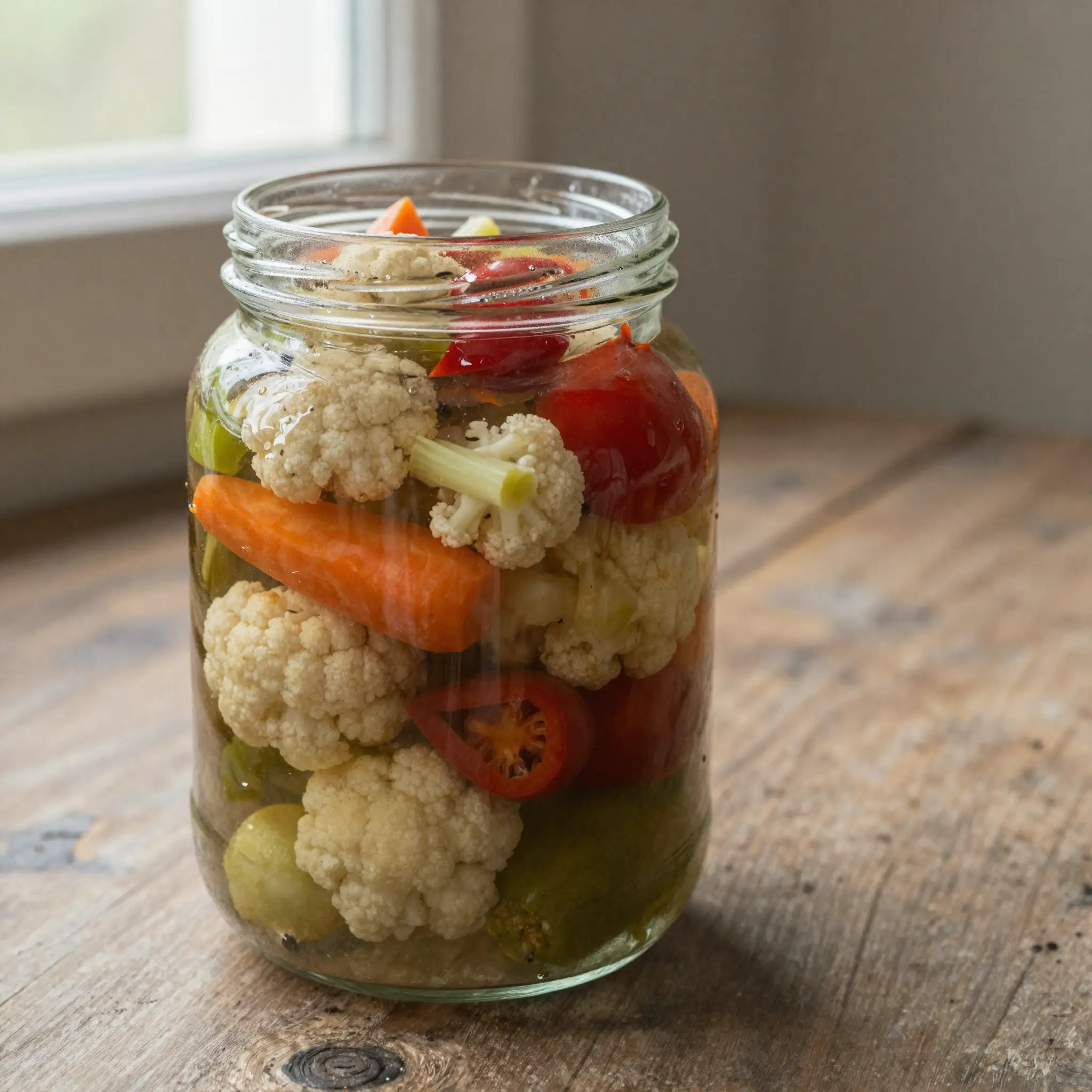
Vegetable
Giardiniera (Italian brine-fermented mixed vegetables)
vegetable-ferment-pickle
Facts
| Category | Vegetable |
|---|---|
| Product family | Giardiniera |
| Origin | 🇮🇹 Italy |
Safety
- Same anaerobic/salinity-floor logic as turşu and sauerkraut. Safe-practice guidance:
(a) adequate salt brine;
(b) full submersion of all solids — exposed vegetable above the brine line is the common failure point;
(c) target pH ≤4.6;
(d) if finishing under oil, do so only after the ferment is fully acidified and refrigerate — an oil layer over an under-acidified low-acid vegetable is its own anaerobic-hazard checkpoint (do not store an unacidified oil-covered preparation at room temperature).
Method
Giardiniera (Italian Brine-Fermented Mixed Vegetables)
- Mixed firm vegetables — cauliflower florets, carrot, celery, bell pepper, small onion — ~1.2 kg total
- Non-iodized salt — for a ~2–5% brine (illustrative) — SAFETY CONTROL, see linked Variant
- Water — enough to submerge (~1–1.5 L)
- Optional finishing (after ferment): extra-virgin olive oil, oregano (flavour only, non-safety)
- 1
Step 1
Cut vegetables into even bite-size pieces (even sizing = even fermentation).
- 2
Step 2
Dissolve salt in water to target brine strength.
- 3
Step 3
Pack vegetables into a jar/crock.
- 4
Step 4
Pour brine over to cover; press below the surface.
- 5
Step 5
Weight so all solids stay submerged.
- 6
Step 6
Cover breathably; ferment at ambient-to-cool temperature 1–3+ weeks to desired sourness.
- 7
Step 7
Refrigerate once at target flavour. If dressing with oil, do so only after full acidification and keep refrigerated.
Frequently asked questions
- What is Giardiniera (Italian brine-fermented mixed vegetables)?
- vegetable-ferment-pickle
- Where does Giardiniera (Italian brine-fermented mixed vegetables) come from?
- Giardiniera (Italian brine-fermented mixed vegetables) is traditionally made in Italy.
- Is Giardiniera (Italian brine-fermented mixed vegetables) safe to make at home?
- Same anaerobic/salinity-floor logic as turşu and sauerkraut. Safe-practice guidance:
(a) adequate salt brine;
(b) full submersion of all solids — exposed vegetable above the brine line is the common failure point;
(c) target pH ≤4.6;
(d) if finishing under oil, do so only after the ferment is fully acidified and refrigerate — an oil layer over an under-acidified low-acid vegetable is its own anaerobic-hazard checkpoint (do not store an unacidified oil-covered preparation at room temperature).
Community results
No community results published for this ferment yet.