
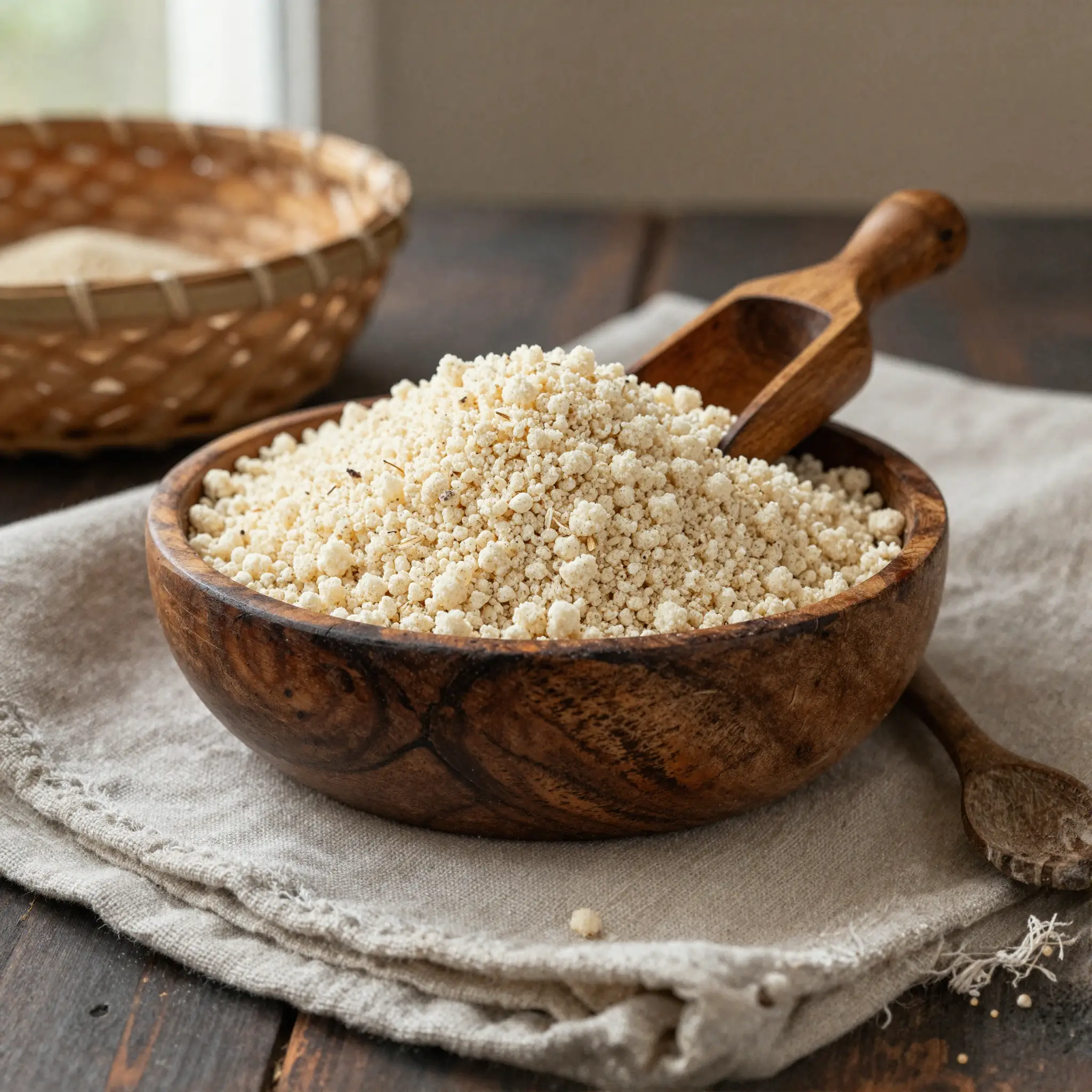
Gari/Garri
Gari (Garri)
Staple/starch
Facts
| Category | Vegetable |
|---|---|
| Origin | 🇳🇬 Nigeria |
Safety
- Documented risk factor — cassava contains naturally occurring cyanogenic glycosides (linamarin and related compounds), which release toxic cyanide compounds upon tissue damage/processing; inadequate processing (insufficient fermentation and/or insufficient subsequent roasting/drying) is a well-documented cause of cyanide-related illness (including, in severe chronic-exposure contexts, konzo, a neurological condition documented in some cassava-dependent populations with inadequate processing practice). Safe-practice guidance:
(a) the fermentation step itself is not merely a flavor/preservation step for this product — it is a necessary detoxification step, since LAB fermentation and the associated enzymatic activity substantially reduce cyanogenic glycoside content during the multi-day fermentation window;
(b) the subsequent roasting/toasting step provides a second, heat-driven detoxification mechanism (volatilization of remaining cyanide compounds) and must not be skipped or abbreviated;
(c) both steps together are the traditional, empirically-derived safe-processing sequence — this is a rare case where the fermentation step's primary documented function is food-safety detoxification, not merely flavor/preservation, and this should be foregrounded prominently in any consumer-facing FRMNT content for this product, not treated as a secondary note.
Method
Gari (Fermented, Pressed and Roasted Cassava)
- Cassava roots — 5 kg. Cassava is cyanogenic. The fermentation, pressing and roasting steps below are not flavour steps — they are the detoxification process, and the linked Variant's item 8 is authoritative on this. Read it before making this recipe.
- Optional: red palm oil, for the yellow (gari pupuru-style) variant (flavour/colour only, non-safety)
- 1
Step 1
Peel the cassava roots and wash them thoroughly.
- 2
Step 2
Grate the peeled cassava to a mash — the grating matters: it ruptures the cells, which is what allows the cyanogenic compounds to be broken down and released in the steps that follow.
- 3
Step 3
Pack the grated mash into sacks or perforated containers.
- 4
Step 4
Ferment the mash for 1–4 days — the LAB acidify it and, critically, this stage facilitates the breakdown and release of the cyanogenic compounds — SAFETY CONTROL: do not shorten this stage, see linked Variant.
- 5
Step 5
Press the fermenting mash under weight to expel the liquid, which carries dissolved cyanogenic breakdown products away with it — SAFETY CONTROL, see linked Variant.
- 6
Step 6
Sieve the pressed cake into a granular meal, breaking up lumps.
- 7
Step 7
Roast (garify) the meal in a wide pan over heat, stirring constantly until the grains are dry, hard and lightly toasted — this drives off residual volatile compounds and dries the product — SAFETY CONTROL, see linked Variant.
- 8
Step 8
Cool the roasted gari completely.
- 9
Step 9
Store dry and sealed.
Frequently asked questions
- What is Gari/Garri?
- Staple/starch
- Where does Gari/Garri come from?
- Gari/Garri is traditionally made in Nigeria.
- Is Gari/Garri safe to make at home?
- Documented risk factor — cassava contains naturally occurring cyanogenic glycosides (linamarin and related compounds), which release toxic cyanide compounds upon tissue damage/processing; inadequate processing (insufficient fermentation and/or insufficient subsequent roasting/drying) is a well-documented cause of cyanide-related illness (including, in severe chronic-exposure contexts, konzo, a neurological condition documented in some cassava-dependent populations with inadequate processing practice). Safe-practice guidance:
(a) the fermentation step itself is not merely a flavor/preservation step for this product — it is a necessary detoxification step, since LAB fermentation and the associated enzymatic activity substantially reduce cyanogenic glycoside content during the multi-day fermentation window;
(b) the subsequent roasting/toasting step provides a second, heat-driven detoxification mechanism (volatilization of remaining cyanide compounds) and must not be skipped or abbreviated;
(c) both steps together are the traditional, empirically-derived safe-processing sequence — this is a rare case where the fermentation step's primary documented function is food-safety detoxification, not merely flavor/preservation, and this should be foregrounded prominently in any consumer-facing FRMNT content for this product, not treated as a secondary note.
Community results
No community results published for this ferment yet.