
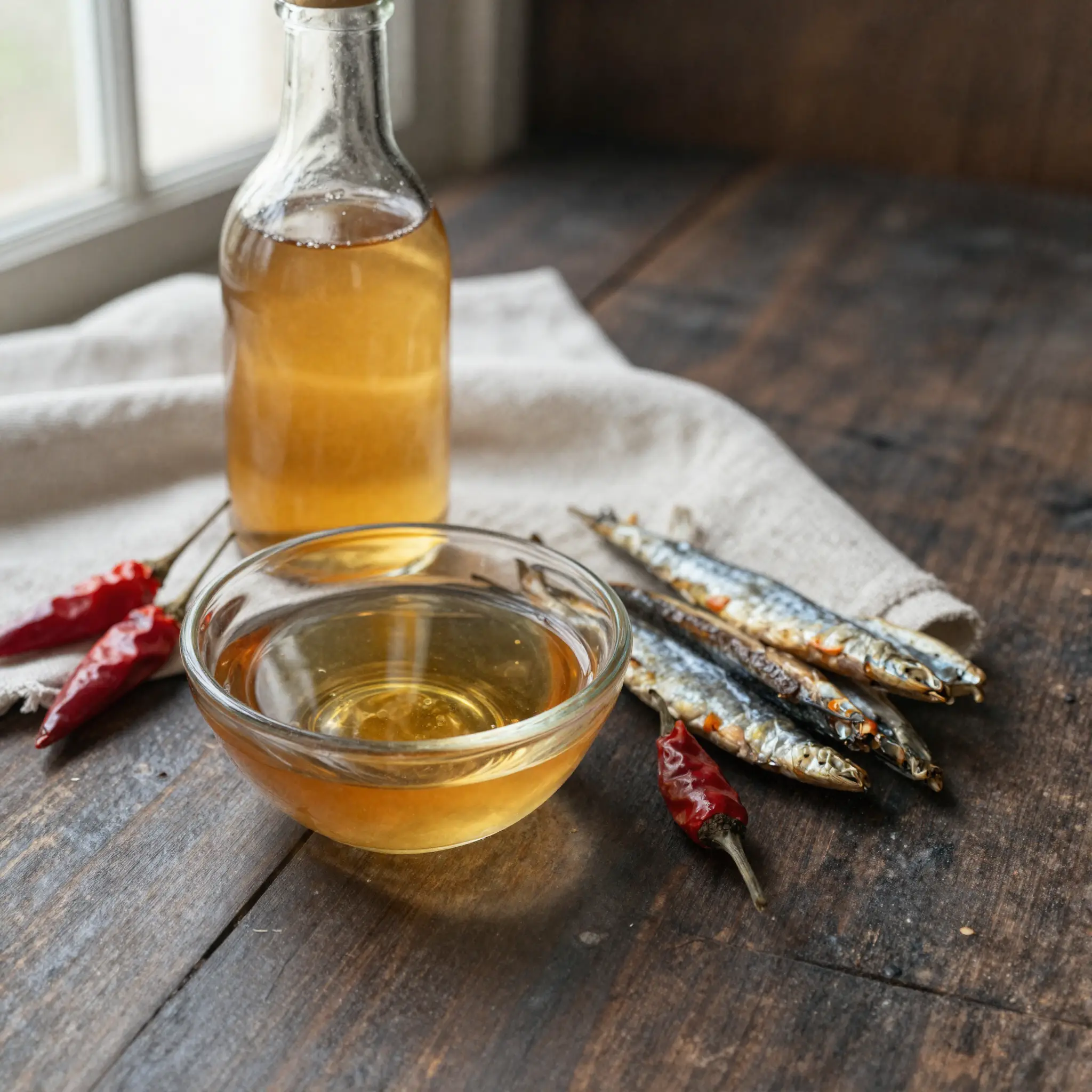
Fish Sauce
Condiment
Facts
| Category | Meat / Fish |
|---|---|
| Origin | 🇻🇳 Vietnam |
Safety
- (i) Salinity-floor/anaerobic risk — raw fish protein is intrinsically more perishable than plant or dairy substrates, and the fermentation window (months to years) is the longest of any family; the combination of a highly putrescible raw material, extended anaerobic conditions, and multi-month-to-multi-year timeframe makes inadequate salt concentration a materially serious hazard (classic spoilage/putrefaction and, in principle, anaerobic pathogen risk in an inadequately salted, sealed, anaerobic protein mass). (ii) Histamine/biogenic amine formation — certain bacteria can decarboxylate histidine (abundant in some fish species, notably scombroid-family fish such as anchovy) into histamine during fermentation/storage, causing scombroid-type food poisoning (flushing, headache, gastrointestinal symptoms, distinct from an infectious-pathogen illness) if fish freshness/temperature control is inadequate before or during fermentation. (iii) Standard spoilage risk from inadequate starting-fish freshness, independent of the two hazards above. Safe-practice guidance:
(a) traditional/commercial salt-to-fish ratios are reported in the literature as substantially higher than vegetable-ferment salinity, precisely because of the much longer timeframe and more hazard-prone substrate — this is not independently confirmed as specific to this product(explicitly flagged as an unresolved evidence gap);
(b) fish freshness at the point of salting is itself a critical input control, since both putrefactive spoilage and histamine formation are accelerated by delayed/inadequate initial handling — only fresh (not previously temperature-abused) fish should be used;
(c) histamine is heat-stable and not eliminated by later processing/cooking, making upstream freshness/temperature control the only effective mitigation.
Method
Fish Sauce (Salted Anchovy Autolysis)
- Fresh whole anchovy (or other small whole fish) — 3 kg. Freshness at the start is decisive: this is a year-long ambient ferment of raw fish, and it cannot correct for fish that was already degrading — see the linked Variant.
- Non-iodized salt — a high proportion of the fish weight (conventionally around a 3:1 fish:salt ratio, illustrative) — SAFETY CONTROL, see linked Variant
- 1
Step 1
Start with very fresh whole fish; do not gut them — the viscera carry the endogenous proteolytic enzymes that drive the whole process.
- 2
Step 2
Mix the fish thoroughly with the salt until every fish is coated.
- 3
Step 3
Pack the salted fish tightly into a clean vessel, excluding excess air.
- 4
Step 4
Weight the mass so the liquid that forms rises above the solids — SAFETY CONTROL (the high-salt liquid is the protective environment), see linked Variant.
- 5
Step 5
Cover and leave at ambient (often warm) temperature.
- 6
Step 6
Ferment for many months to over a year as the fish autolyses and liquefies; the salt holds spoilage organisms off across that whole span.
- 7
Step 7
Press or drain off the amber liquid.
- 8
Step 8
Filter it clear, then bottle.
Frequently asked questions
- What is Fish Sauce?
- Condiment
- Where does Fish Sauce come from?
- Fish Sauce is traditionally made in Vietnam.
- Is Fish Sauce safe to make at home?
- (i) Salinity-floor/anaerobic risk — raw fish protein is intrinsically more perishable than plant or dairy substrates, and the fermentation window (months to years) is the longest of any family; the combination of a highly putrescible raw material, extended anaerobic conditions, and multi-month-to-multi-year timeframe makes inadequate salt concentration a materially serious hazard (classic spoilage/putrefaction and, in principle, anaerobic pathogen risk in an inadequately salted, sealed, anaerobic protein mass). (ii) Histamine/biogenic amine formation — certain bacteria can decarboxylate histidine (abundant in some fish species, notably scombroid-family fish such as anchovy) into histamine during fermentation/storage, causing scombroid-type food poisoning (flushing, headache, gastrointestinal symptoms, distinct from an infectious-pathogen illness) if fish freshness/temperature control is inadequate before or during fermentation. (iii) Standard spoilage risk from inadequate starting-fish freshness, independent of the two hazards above. Safe-practice guidance:
(a) traditional/commercial salt-to-fish ratios are reported in the literature as substantially higher than vegetable-ferment salinity, precisely because of the much longer timeframe and more hazard-prone substrate — this is not independently confirmed as specific to this product(explicitly flagged as an unresolved evidence gap);
(b) fish freshness at the point of salting is itself a critical input control, since both putrefactive spoilage and histamine formation are accelerated by delayed/inadequate initial handling — only fresh (not previously temperature-abused) fish should be used;
(c) histamine is heat-stable and not eliminated by later processing/cooking, making upstream freshness/temperature control the only effective mitigation.
Community results
No community results published for this ferment yet.