
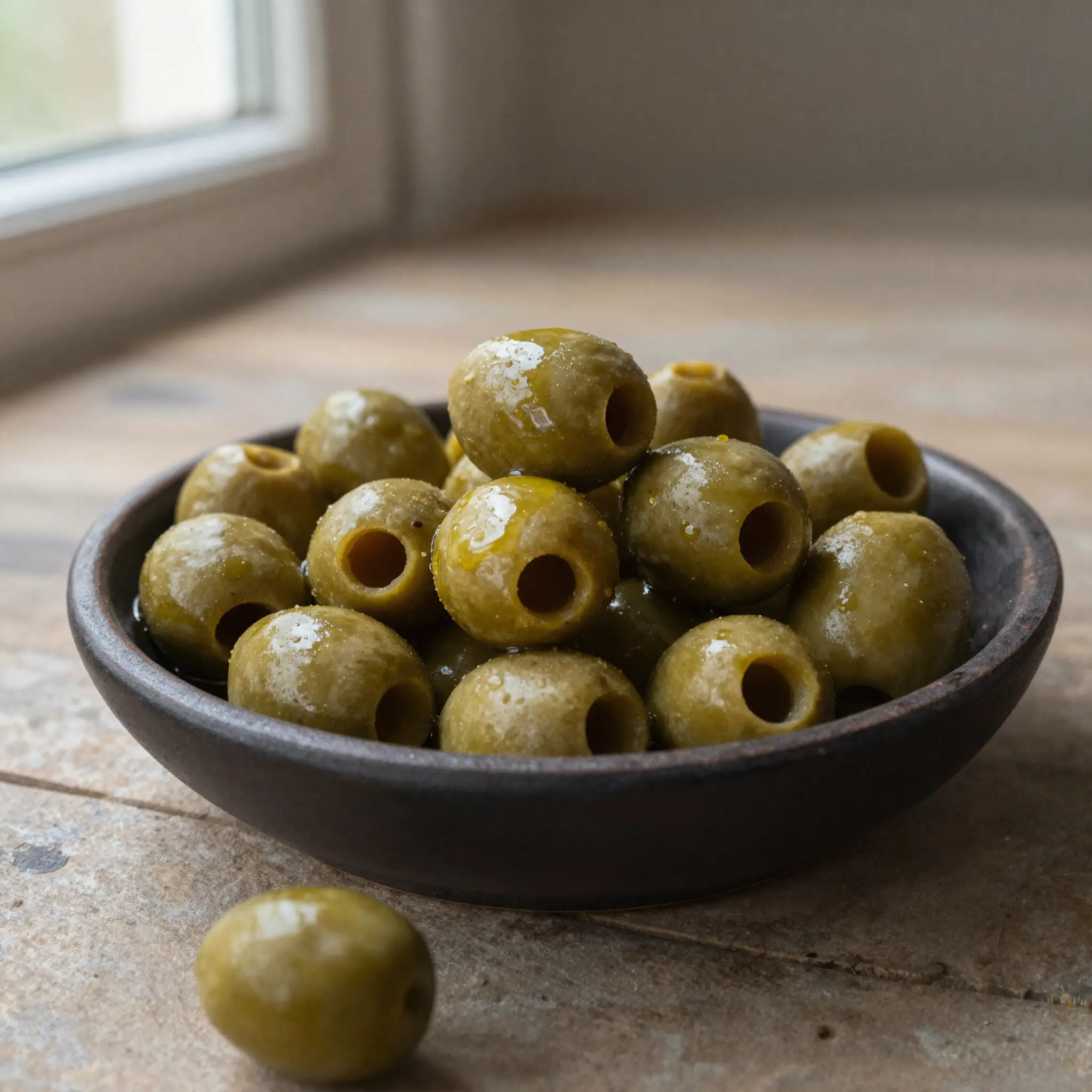
Greek naturally fermented table olives
Greek naturally fermented table olives (Greek-style black/Kalamata natural process)
vegetable-ferment-pickle
Facts
| Category | Fruit |
|---|---|
| Product family | Fermented Table Olives |
| Origin | 🇬🇷 Greece |
Safety
- Documented risk factors are
(a) inadequate brine salinity or loss of submersion permitting spoilage, and
(b) "zapatera"/gassy spoilage (off-odour, softening, gas pockets) from undesirable microbial activity when acidification or salinity is insufficient. Safe-practice guidance:
(a) maintain adequate brine salinity throughout the long (multi-month) cure — the extended window raises the stakes of an under-salted brine relative to a fast vegetable ferment;
(b) keep olives submerged;
(c) monitor for softening/off-odour/gas as actionable spoilage signals distinct from the desired sour cure;
(d) precise salinity/pH targets for table olives are governed by dedicated standards (International Olive Council / Codex) — treat the figures above as illustrative and re-source authority-grade thresholds before publishing hard consumer numbers.
Method
Greek Naturally Fermented Table Olives (Natural Black / Kalamata Process)
- Fresh olives (Olea europaea), naturally-processed cultivar (e.g. Kalamata, Conservolea) — 2 kg
- Non-iodized salt — quantity to make and maintain an ~8–10% brine (illustrative) — SAFETY CONTROL, see linked Variant
- Water — enough to fully submerge
- Optional finishing (after cure): red wine vinegar, olive oil, herbs (flavour only, non-safety)
- 1
Step 1
Sort olives; discard bruised/damaged fruit.
- 2
Step 2
(Optional, traditional) slit or lightly crack each olive to speed brine penetration and debittering.
- 3
Step 3
Pack olives into a food-grade vessel.
- 4
Step 4
Cover fully with the salt brine at target strength.
- 5
Step 5
Keep olives submerged (a plate/weight); cover breathably.
- 6
Step 6
Ferment/cure at cool ambient temperature for several months, checking that solids stay submerged and topping up brine strength as needed.
- 7
Step 7
Taste periodically from ~2 months: the bitterness recedes as fermentation/diffusion removes oleuropein.
- 8
Step 8
When debittered and pleasantly sour, transfer to fresh brine for storage; finish/dress at serving.
Frequently asked questions
- What is Greek naturally fermented table olives?
- vegetable-ferment-pickle
- Where does Greek naturally fermented table olives come from?
- Greek naturally fermented table olives is traditionally made in Greece.
- Is Greek naturally fermented table olives safe to make at home?
- Documented risk factors are
(a) inadequate brine salinity or loss of submersion permitting spoilage, and
(b) "zapatera"/gassy spoilage (off-odour, softening, gas pockets) from undesirable microbial activity when acidification or salinity is insufficient. Safe-practice guidance:
(a) maintain adequate brine salinity throughout the long (multi-month) cure — the extended window raises the stakes of an under-salted brine relative to a fast vegetable ferment;
(b) keep olives submerged;
(c) monitor for softening/off-odour/gas as actionable spoilage signals distinct from the desired sour cure;
(d) precise salinity/pH targets for table olives are governed by dedicated standards (International Olive Council / Codex) — treat the figures above as illustrative and re-source authority-grade thresholds before publishing hard consumer numbers.
Community results
No community results published for this ferment yet.