
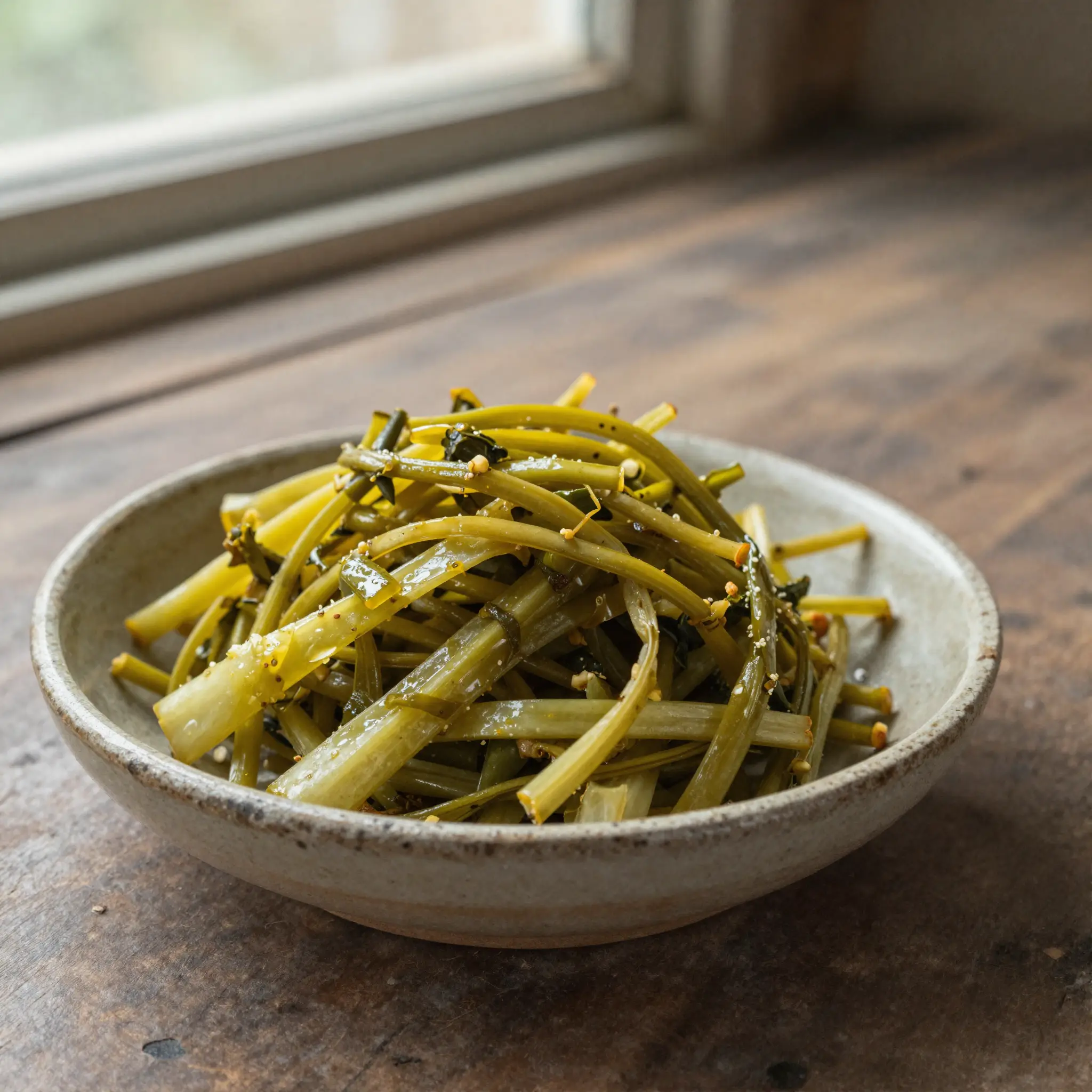
Dưa chua / dưa cải (Vietnamese brine-fermented mustard greens)
vegetable-ferment-pickle
Facts
| Category | Vegetable |
|---|---|
| Product family | Southeast Asian Brined Lactic Leafy-Green Pickle |
| Origin | 🇻🇳 Vietnam |
Safety
- As with the other two entries in this sub-batch, dưa chua/dưa cải-specific quantified safety literature is thinner than the brine-vegetable ferments in /02 — stated explicitly. The general brined-vegetable safety mechanism applies: documented risk factor is insufficient brine salinity or vegetables left exposed above the brine line, permitting spoilage organisms and, in a low-acid anaerobic pocket before acidification completes, a theoretical Clostridium botulinum concern. Safe-practice guidance:
(a) maintain an adequate salt brine and keep all solids fully submerged below the brine line — the short (2–5 day) fermentation window here means under-salting is a comparatively fast-acting failure mode;
(b) discard on putrid odour, sliminess, or mould rather than the expected sour smell/taste and typical harmless surface bloom;
(c) once at target sourness, refrigerate to slow further acidification and extend safe use;
(d) precise pH/salinity regulatory-grade floors specific to dưa chua are not established — the illustrative brine percentage above is a common home-practice figure, not a sourced regulatory threshold.
Method
Dưa Chua / Dưa Cải (Vietnamese Brine-Fermented Mustard Greens)
- Mustard greens (or related leafy brassica, "cải") — ~1000 g
- Scallion/spring onion — a few stalks, cut into segments (traditional addition)
- Non-iodized salt — quantity to make a ~2–4% brine (illustrative) — SAFETY CONTROL, see linked Variant
- Water — enough to fully submerge (~1–1.5 L)
- Optional traditional additions: a small amount of sugar and/or cooled boiled rice-water, to support the ferment (flavour/tradition, not itself the safety control)
- 1
Step 1
Wash the mustard greens; wilt briefly in the sun or air-dry for a few hours to soften slightly.
- 2
Step 2
Cut the greens into segments; combine with cut scallion.
- 3
Step 3
Prepare the brine: dissolve salt (and optional sugar) fully in water.
- 4
Step 4
Pack the greens and scallion tightly into a clean jar.
- 5
Step 5
Pour the brine over to fully cover; press the vegetables below the surface.
- 6
Step 6
Weight or wedge the vegetables so all solids stay submerged below the brine line.
- 7
Step 7
Cover breathably; ferment at ambient room temperature.
- 8
Step 8
Check daily: confirm submersion; skim any surface film.
- 9
Step 9
Taste from day 2 onward; ferment to desired sourness, typically 2–5 days (illustrative).
- 10
Step 10
Refrigerate once at target sourness to slow further souring; serve as a side dish/condiment.
Frequently asked questions
- What is Dưa chua / dưa cải (Vietnamese brine-fermented mustard greens)?
- vegetable-ferment-pickle
- Where does Dưa chua / dưa cải (Vietnamese brine-fermented mustard greens) come from?
- Dưa chua / dưa cải (Vietnamese brine-fermented mustard greens) is traditionally made in Vietnam.
- Is Dưa chua / dưa cải (Vietnamese brine-fermented mustard greens) safe to make at home?
- As with the other two entries in this sub-batch, dưa chua/dưa cải-specific quantified safety literature is thinner than the brine-vegetable ferments in /02 — stated explicitly. The general brined-vegetable safety mechanism applies: documented risk factor is insufficient brine salinity or vegetables left exposed above the brine line, permitting spoilage organisms and, in a low-acid anaerobic pocket before acidification completes, a theoretical Clostridium botulinum concern. Safe-practice guidance:
(a) maintain an adequate salt brine and keep all solids fully submerged below the brine line — the short (2–5 day) fermentation window here means under-salting is a comparatively fast-acting failure mode;
(b) discard on putrid odour, sliminess, or mould rather than the expected sour smell/taste and typical harmless surface bloom;
(c) once at target sourness, refrigerate to slow further acidification and extend safe use;
(d) precise pH/salinity regulatory-grade floors specific to dưa chua are not established — the illustrative brine percentage above is a common home-practice figure, not a sourced regulatory threshold.
Community results
No community results published for this ferment yet.