
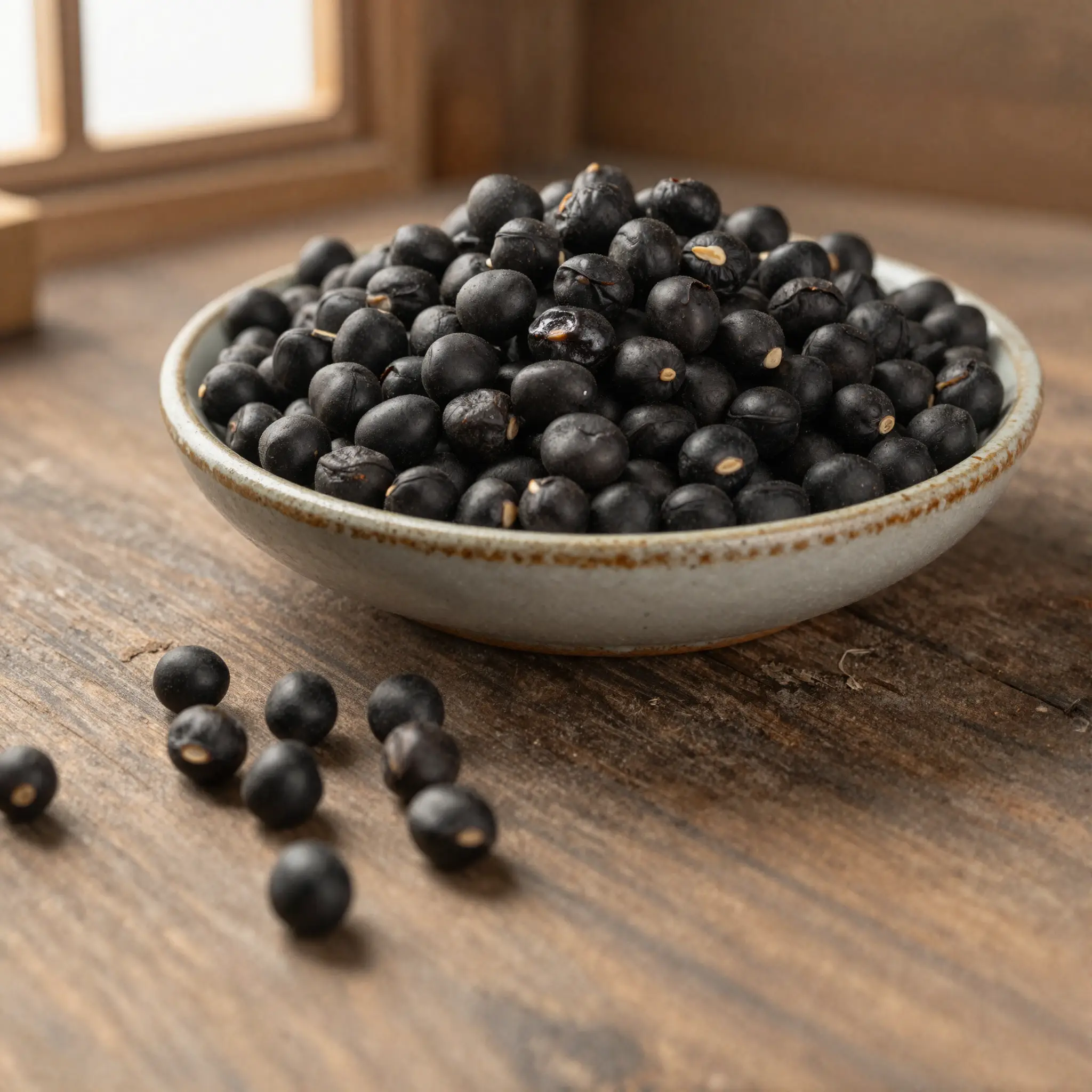
Douchi (Chinese fermented black soybean condiment)
Condiment/paste
Facts
| Category | Grain / Legume |
|---|---|
| Product family | Chinese Fermented Black Soybean Condiment |
| Origin | 🇨🇳 China |
| Key microorganisms | bacillus-spp, filamentous-fungi-molds |
Safety
- Documented considerations (honest, soy/legume-appropriate, mirroring both possible pathways):
(a) douchi requires adequate cooking of the raw black soybeans before fermentation, both to soften them for microbial access and, generally, to reduce anti-nutrient/lectin content typical of raw legumes — this is not independently confirmed as specific to this product, since none are independently documented;
(b) under the mold/Aspergillus pathway, the same intended-vs-spoilage-mould distinction applies as for Sufu and Doubanjiang — a deliberately cultivated, food-safe mold culture is required, categorically distinct from incidental/uncontrolled spoilage mould, and beans showing atypical colouration or off-odours inconsistent with the intended culture/process should be discarded, not used;
(c) under the Bacillus/alkaline pathway, as with other Bacillus-soybean ferments, a genuinely fermented batch should develop a characteristic pungent, savoury aroma consistent with the intended process — any distinctly foul, ammonia-heavy, or otherwise off odour inconsistent with a healthy ferment should prompt discarding rather than use;
(d) the salting/drying stage is a defining, safety-relevant step — sufficient salt and drying inhibit undesired microbial growth during storage, though this is not independently confirmed as specific to this product, water-activity, or pH figure, since none is independently documented for this specific product;
(e) the soybean substrate carries the general soy-allergen consideration — douchi is not suitable for individuals with soybean allergy;
(f) potable water and clean equipment must be used throughout cooking, fermentation, and salting. Safe-practice guidance: cook raw black soybeans thoroughly before fermenting; under the mold pathway, use a known food-safe mold starter and discard beans with atypical colouration or off-odour; under the Bacillus pathway, confirm a genuinely pungent-but-not-foul aroma as the sign of a safely proceeding ferment; ensure adequate salting and drying for safe storage, without asserting a specific numeric threshold; be aware of the soy-allergen status of the finished product; use potable water and clean equipment throughout. No specific pathogen thresholds, salt-percentage figures, pH figures, or fermentation/drying-duration numerics are asserted — any such figure is illustrative or not established.
Method
Douchi (Chinese Fermented Black Soybean Condiment)
- Black soybean (whole, dried) — ~500 g
- Water — potable, for cooking/steaming the beans
- Starter, pathway-dependent (SAFETY CONTROL item, choose one documented pathway, not an undefined mixture):
- Bacillus pathway: a known Bacillus-based starter or reliance on naturally-occurring Bacillus per traditional practice, OR
- Mold pathway: a known food-safe Aspergillus mold starter culture
- Salt — for dry-salting and/or brine, quantity (illustrative)
- 1
Step 1
Clean and cook/steam the dried black soybeans until soft.
- 2
Step 2
Choose and apply one documented fermentation pathway:
(a) inoculate with/expose to Bacillus and incubate under warm, humid conditions until surface-tacky and pungent, or
(b) inoculate with an Aspergillus mold starter and incubate until mold-coated. - 3
Step 3
Once the chosen fermentation stage is complete (duration illustrative, tradition- and pathway-variable, not separately confirmed for this specific product), salt the fermented beans (dry-salt or brine).
- 4
Step 4
Spread and dry the salted beans, traditionally in the sun or a controlled drying environment, until dark, wrinkled, and firm.
- 5
Step 5
Store the finished dry douchi beans in a clean, dry, sealed container.
- 6
Step 6
Use whole or minced as a seasoning/condiment in cooking.
Frequently asked questions
- What is Douchi (Chinese fermented black soybean condiment)?
- Condiment/paste
- Which microorganisms ferment Douchi (Chinese fermented black soybean condiment)?
- Douchi (Chinese fermented black soybean condiment) is primarily driven by bacillus-spp, filamentous-fungi-molds.
- Where does Douchi (Chinese fermented black soybean condiment) come from?
- Douchi (Chinese fermented black soybean condiment) is traditionally made in China.
- Is Douchi (Chinese fermented black soybean condiment) safe to make at home?
- Documented considerations (honest, soy/legume-appropriate, mirroring both possible pathways):
(a) douchi requires adequate cooking of the raw black soybeans before fermentation, both to soften them for microbial access and, generally, to reduce anti-nutrient/lectin content typical of raw legumes — this is not independently confirmed as specific to this product, since none are independently documented;
(b) under the mold/Aspergillus pathway, the same intended-vs-spoilage-mould distinction applies as for Sufu and Doubanjiang — a deliberately cultivated, food-safe mold culture is required, categorically distinct from incidental/uncontrolled spoilage mould, and beans showing atypical colouration or off-odours inconsistent with the intended culture/process should be discarded, not used;
(c) under the Bacillus/alkaline pathway, as with other Bacillus-soybean ferments, a genuinely fermented batch should develop a characteristic pungent, savoury aroma consistent with the intended process — any distinctly foul, ammonia-heavy, or otherwise off odour inconsistent with a healthy ferment should prompt discarding rather than use;
(d) the salting/drying stage is a defining, safety-relevant step — sufficient salt and drying inhibit undesired microbial growth during storage, though this is not independently confirmed as specific to this product, water-activity, or pH figure, since none is independently documented for this specific product;
(e) the soybean substrate carries the general soy-allergen consideration — douchi is not suitable for individuals with soybean allergy;
(f) potable water and clean equipment must be used throughout cooking, fermentation, and salting. Safe-practice guidance: cook raw black soybeans thoroughly before fermenting; under the mold pathway, use a known food-safe mold starter and discard beans with atypical colouration or off-odour; under the Bacillus pathway, confirm a genuinely pungent-but-not-foul aroma as the sign of a safely proceeding ferment; ensure adequate salting and drying for safe storage, without asserting a specific numeric threshold; be aware of the soy-allergen status of the finished product; use potable water and clean equipment throughout. No specific pathogen thresholds, salt-percentage figures, pH figures, or fermentation/drying-duration numerics are asserted — any such figure is illustrative or not established.
Community results
No community results published for this ferment yet.