
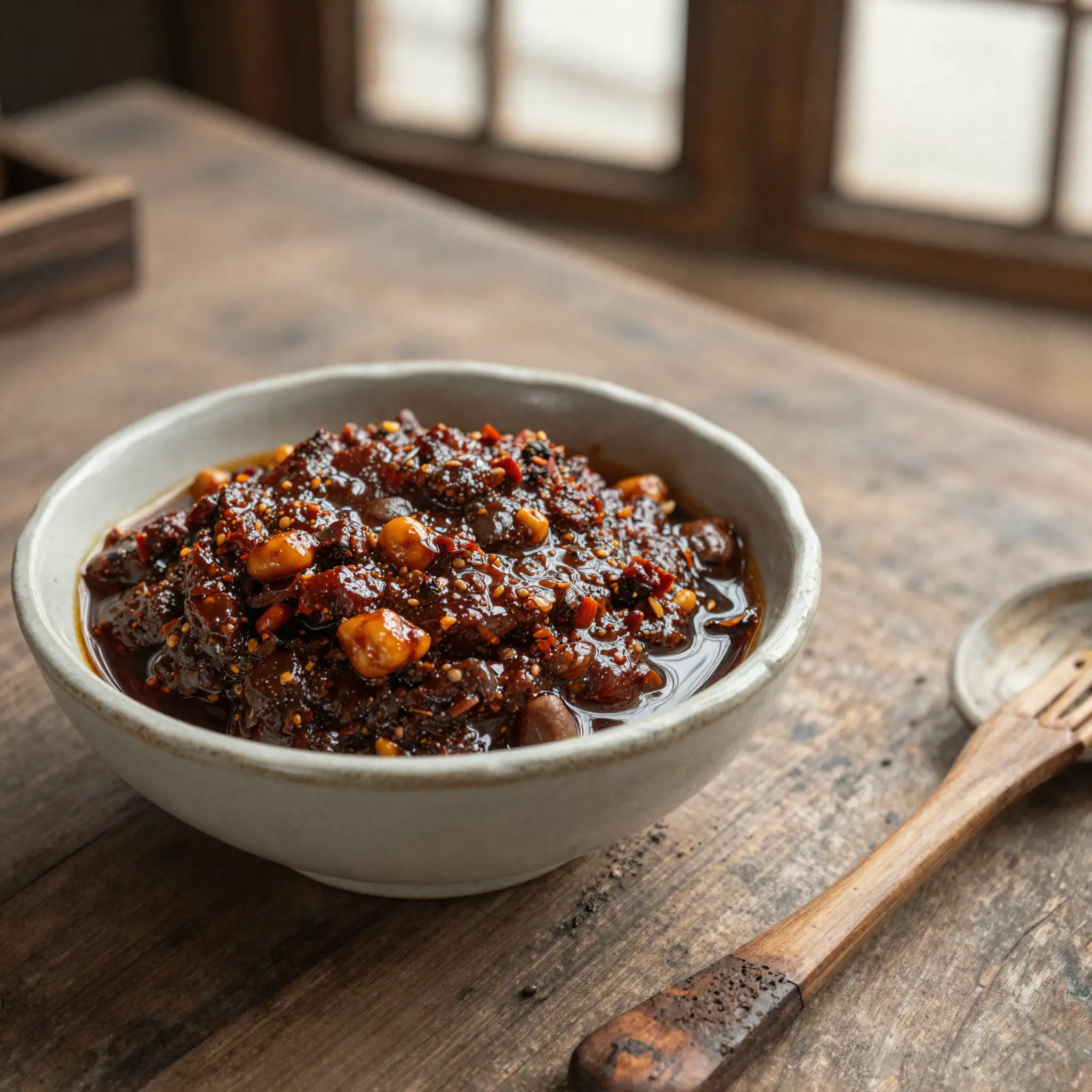
Doubanjiang (Sichuan fermented broad bean and chili paste)
Doubanjiang (Sichuan fermented broad/fava bean and chili paste)
Condiment/paste
Facts
| Category | Grain / Legume |
|---|---|
| Product family | Sichuan Fermented Broad-Bean Chili Paste |
| Origin | 🇨🇳 China |
| Key microorganisms | filamentous-fungi-molds, lactic-acid-bacteria |
Safety
- Documented considerations (honest, soy/legume-appropriate):
(a) doubanjiang requires adequate cooking of the raw broad (fava) beans before the mold-inoculation stage, both to soften them for koji growth and, generally, to reduce anti-nutrient content typical of raw legumes; this entry additionally notes, honestly and without asserting a product-specific quantified claim, the general awareness that raw or undercooked fava beans carry a well-documented risk of favism (a hemolytic reaction) in individuals with G6PD deficiency — adequate cooking and full fermentation/aging, as used traditionally in doubanjiang production, are the relevant safe-practice context, though this is not independently confirmed as specific to this product, since none are independently documented for the finished fermented product;
(b) the mold/koji stage relies on a deliberately cultivated Aspergillus oryzae culture, categorically distinct from incidental/uncontrolled spoilage mould — beans showing atypical colouration (outside the expected koji-mold appearance) or off-odours should be discarded, not used;
(c) the salting and extended aging stage is a defining, safety-relevant step — sufficient salt supports the paste's safe extended aging and inhibits undesired microbial growth, though this is not independently confirmed as specific to this product, since none is independently documented for this specific product;
(d) the substrate carries the general legume-allergen consideration (fava bean; and, where wheat flour is used in the koji stage, a gluten consideration by general-knowledge analogy, not independently confirmed for this product's exact recipe) — consumers with relevant allergies/sensitivities should be aware;
(e) potable water and clean equipment must be used throughout. Safe-practice guidance: cook raw broad beans thoroughly before the mold-inoculation stage; use a known, food-safe Aspergillus oryzae koji culture and discard beans with atypical colouration or off-odour; ensure adequate salting for safe extended aging, without asserting a specific numeric threshold; be aware of the general favism consideration for raw/undercooked fava beans and rely on traditional full-cooking-and-fermentation practice; be aware of the legume (and possible gluten) allergen status of the finished product; use potable water and clean equipment throughout. No specific pathogen thresholds, salt-percentage figures, pH figures, or aging-duration numerics are asserted — any such figure is illustrative or not established.
Method
Doubanjiang (Sichuan Fermented Broad Bean and Chili Paste)
- Broad (fava) bean, dehulled — ~500 g
- Aspergillus oryzae koji starter culture — SAFETY CONTROL item, must be a known, food-safe culture
- Wheat flour — small quantity, traditionally used in the koji-inoculation stage (by general-knowledge analogy to other koji ferments, illustrative, not independently itemized in the source)
- Salt — for brining, quantity (illustrative)
- Chili (fresh or salted) — quantity to taste/tradition, blended in during the secondary fermentation stage
- Water — potable, for cooking the beans and forming the brine
- 1
Step 1
Dehull, soak, and cook the broad (fava) beans until soft.
- 2
Step 2
Cool the cooked beans and lightly coat with wheat flour (traditional koji-substrate practice, general-knowledge analogy).
- 3
Step 3
Inoculate with the Aspergillus oryzae koji starter culture.
- 4
Step 4
Incubate under controlled warm, humid conditions until the beans are thoroughly mold-coated (the koji stage).
- 5
Step 5
Combine the mold-ripened beans with salt, brine, and chili (fresh or salted).
- 6
Step 6
Transfer the mixture to an open urn or jar and age for an extended secondary fermentation period, traditionally with periodic sun exposure and stirring, over months to years (duration illustrative, tradition- and grade-variable, not separately confirmed for this specific product).
- 7
Step 7
Once the paste has developed its characteristic deep red-brown colour, thick texture, and pungent, spicy, salty flavour, transfer to clean storage containers.
- 8
Step 8
Use as a foundational seasoning paste in cooking (e.g. mapo tofu, twice-cooked pork).
Frequently asked questions
- What is Doubanjiang (Sichuan fermented broad bean and chili paste)?
- Condiment/paste
- Which microorganisms ferment Doubanjiang (Sichuan fermented broad bean and chili paste)?
- Doubanjiang (Sichuan fermented broad bean and chili paste) is primarily driven by filamentous-fungi-molds, lactic-acid-bacteria.
- Where does Doubanjiang (Sichuan fermented broad bean and chili paste) come from?
- Doubanjiang (Sichuan fermented broad bean and chili paste) is traditionally made in China.
- Is Doubanjiang (Sichuan fermented broad bean and chili paste) safe to make at home?
- Documented considerations (honest, soy/legume-appropriate):
(a) doubanjiang requires adequate cooking of the raw broad (fava) beans before the mold-inoculation stage, both to soften them for koji growth and, generally, to reduce anti-nutrient content typical of raw legumes; this entry additionally notes, honestly and without asserting a product-specific quantified claim, the general awareness that raw or undercooked fava beans carry a well-documented risk of favism (a hemolytic reaction) in individuals with G6PD deficiency — adequate cooking and full fermentation/aging, as used traditionally in doubanjiang production, are the relevant safe-practice context, though this is not independently confirmed as specific to this product, since none are independently documented for the finished fermented product;
(b) the mold/koji stage relies on a deliberately cultivated Aspergillus oryzae culture, categorically distinct from incidental/uncontrolled spoilage mould — beans showing atypical colouration (outside the expected koji-mold appearance) or off-odours should be discarded, not used;
(c) the salting and extended aging stage is a defining, safety-relevant step — sufficient salt supports the paste's safe extended aging and inhibits undesired microbial growth, though this is not independently confirmed as specific to this product, since none is independently documented for this specific product;
(d) the substrate carries the general legume-allergen consideration (fava bean; and, where wheat flour is used in the koji stage, a gluten consideration by general-knowledge analogy, not independently confirmed for this product's exact recipe) — consumers with relevant allergies/sensitivities should be aware;
(e) potable water and clean equipment must be used throughout. Safe-practice guidance: cook raw broad beans thoroughly before the mold-inoculation stage; use a known, food-safe Aspergillus oryzae koji culture and discard beans with atypical colouration or off-odour; ensure adequate salting for safe extended aging, without asserting a specific numeric threshold; be aware of the general favism consideration for raw/undercooked fava beans and rely on traditional full-cooking-and-fermentation practice; be aware of the legume (and possible gluten) allergen status of the finished product; use potable water and clean equipment throughout. No specific pathogen thresholds, salt-percentage figures, pH figures, or aging-duration numerics are asserted — any such figure is illustrative or not established.
Community results
No community results published for this ferment yet.