
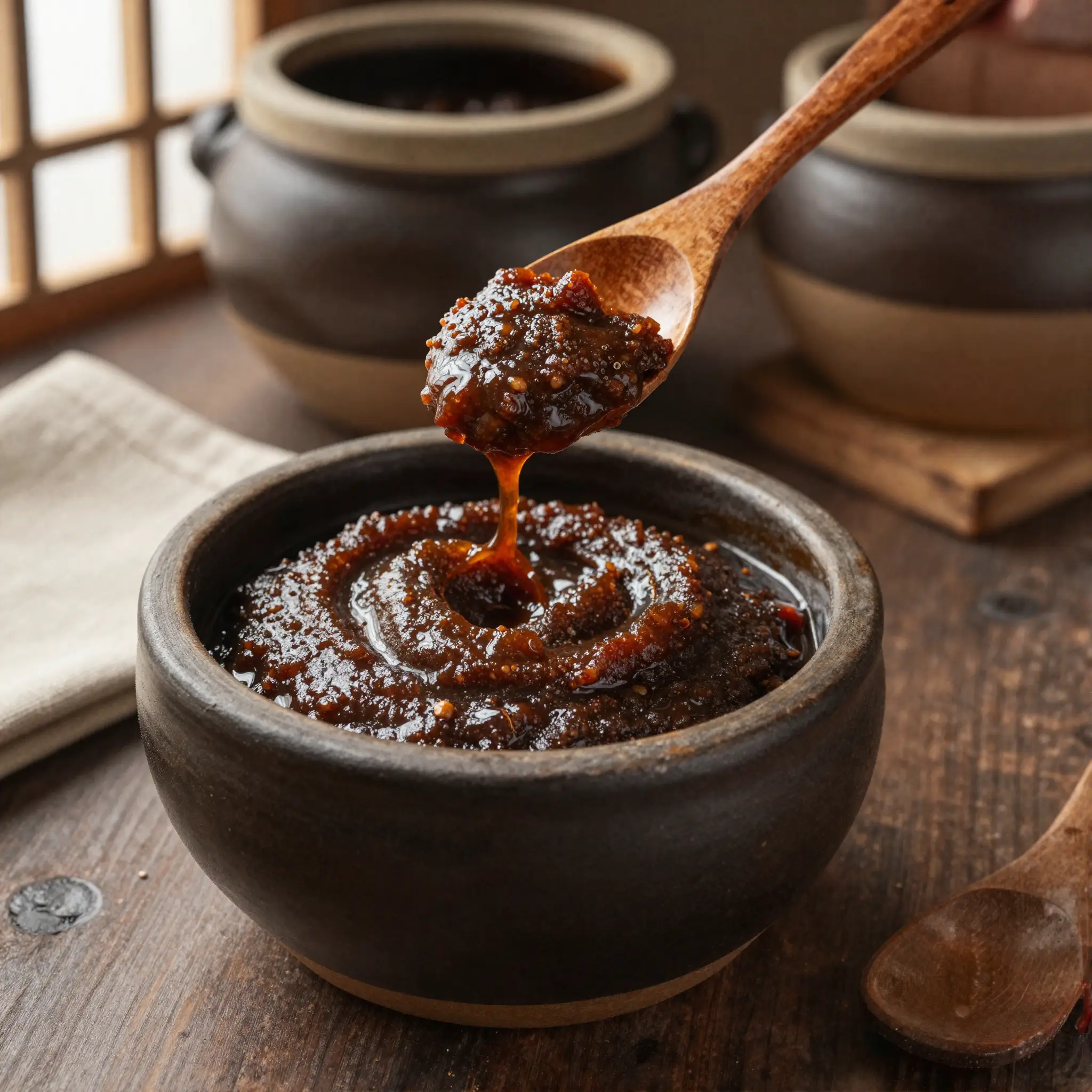
Doenjang
Condiment/paste
Facts
| Category | Grain / Legume |
|---|---|
| Origin | 🇰🇷 South Korea |
Safety
- No significant acute-hazard risk factors documented for properly-aged doenjang. Safe-practice guidance:
(a) the meju-drying/ambient-fermentation stage carries a mold-discrimination consideration analogous to koji and tempeh — traditional practice relies on ambient inoculation (hanging dried blocks in a controlled indoor environment) rather than a single verified commercial spore strain, which is a meaningfully different (and less tightly controlled) risk profile than commercial koji production, worth flagging explicitly rather than assuming identical safety dynamics to miso;
(b) the subsequent high-salt brine stage and extended aging provide a strong inhibitory environment once established, analogous to miso's aging-stage safety profile; (c).
Method
Doenjang (Meju-Based Fermented Soybean Paste)
- Dried soybeans — 1000 g
- Non-iodized salt, for the brine — SAFETY CONTROL, see linked Variant; proportion illustrative
- Water — for the brine
- Optional traditional additions to the brine crock: dried chili, charcoal, jujube (illustrative; traditional practice)
- 1
Step 1
Soak the soybeans overnight, then cook them until soft.
- 2
Step 2
Mash the cooked beans coarsely.
- 3
Step 3
Form the mash into dense blocks (meju), pressing firmly so they hold together.
- 4
Step 4
Dry the surface of the blocks, then hang or shelf them to ferment naturally over weeks — ambient Bacillus and molds colonize them; this is the meju stage and it is a spontaneous ferment, not a defined-starter one.
- 5
Step 5
When the meju are dry, hard, and colonized, brush them clean.
- 6
Step 6
Dissolve the salt in water to make the brine — SAFETY CONTROL, see linked Variant.
- 7
Step 7
Submerge the meju blocks in the brine in a crock and leave them to ferment further.
- 8
Step 8
After the brine ferment, separate the liquid — that liquid becomes ganjang (soy sauce); the remaining solids are the doenjang.
- 9
Step 9
Pack the solids into a crock and age them onward to develop depth.
Frequently asked questions
- What is Doenjang?
- Condiment/paste
- Where does Doenjang come from?
- Doenjang is traditionally made in South Korea.
- Is Doenjang safe to make at home?
- No significant acute-hazard risk factors documented for properly-aged doenjang. Safe-practice guidance:
(a) the meju-drying/ambient-fermentation stage carries a mold-discrimination consideration analogous to koji and tempeh — traditional practice relies on ambient inoculation (hanging dried blocks in a controlled indoor environment) rather than a single verified commercial spore strain, which is a meaningfully different (and less tightly controlled) risk profile than commercial koji production, worth flagging explicitly rather than assuming identical safety dynamics to miso;
(b) the subsequent high-salt brine stage and extended aging provide a strong inhibitory environment once established, analogous to miso's aging-stage safety profile; (c).
Community results
No community results published for this ferment yet.
Related library reading
- Which Countries Have the Most Distinct Traditional Fermented Foods?Korea, China, Japan and India dominate every published count — and what that ranking actually measures is which traditions got written down in English.
- Natto, Thua Nao, Tempeh and Doenjang: The Two Ways Legumes FermentBacillus and mould take soybeans in opposite chemical directions. Which organism runs which ferment, and what that means for smell, texture and use.