
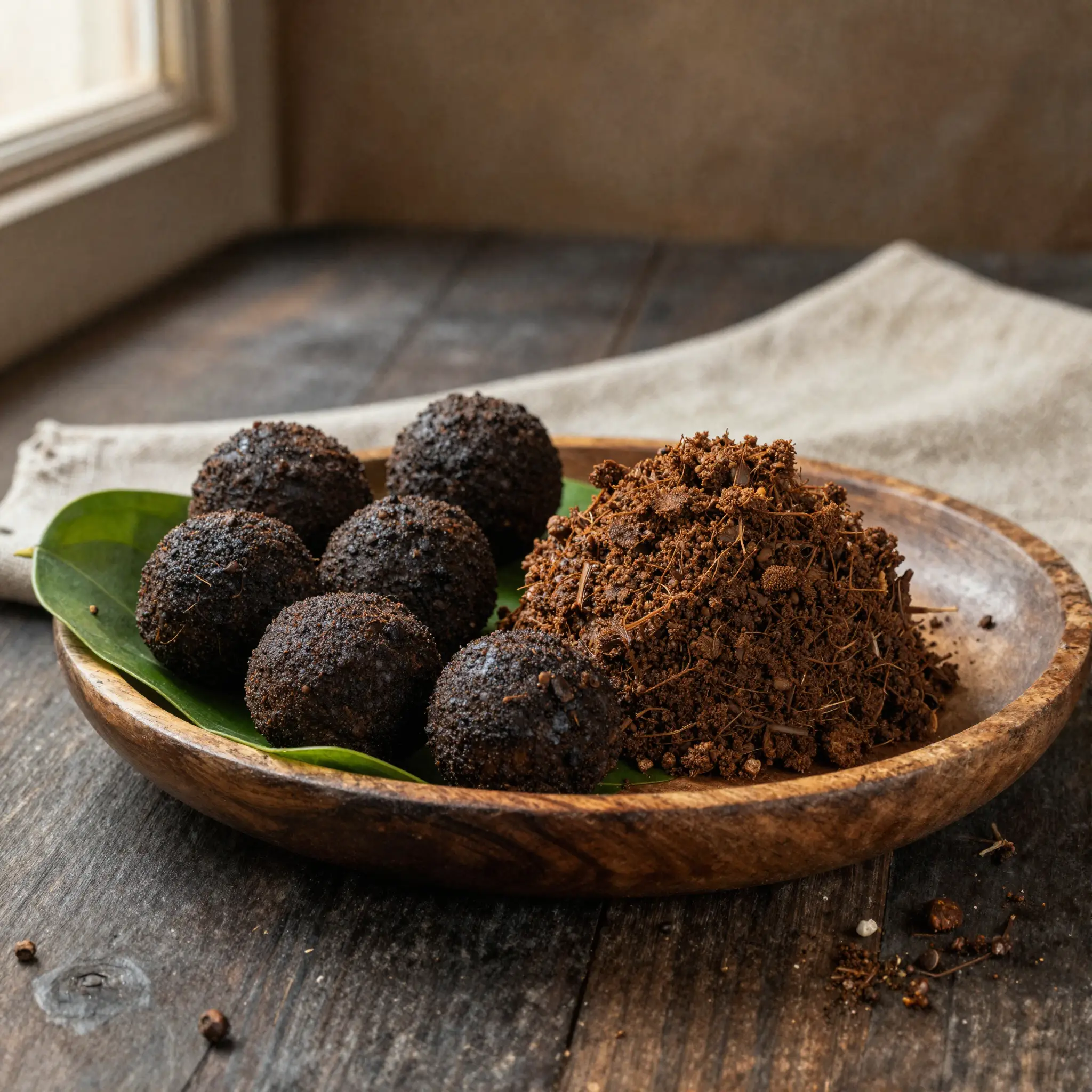
Dawadawa / Iru
Dawadawa/Iru
Condiment
Facts
| Category | Grain / Legume |
|---|---|
| Origin | 🇳🇬 Nigeria |
Safety
- This product shares natto's mechanistically distinct alkaline-fermentation safety profile (pH rises, does not fall) and is explicitly named in the canonical model's own as the single most consequential safety-literature gap on the platform, alongside fish/fish-sauce products. Safe-practice guidance:
(a) the same acid-drop-does-not-apply caution as natto governs this product — safety rests on the initial thorough cook selecting for spore-forming Bacillus survivors, B. subtilis's competitive dominance, and a controlled fermentation window, not on acidification;
(b) traditional leaf-wrapping provides both airflow and an ambient inoculum source in a practice refined over generations, though there is no dedicated published safety-threshold citation for this specific fermentation, peer-reviewed safety-threshold citation specific to locust-bean alkaline fermentation to offer beyond the general Bacillus-mechanism principle shared with natto;
(c) this is the single most significant safety-evidence flag for a West African product — the canonical model's explicitly names "West African alkaline ferments" as needing a dedicated safety-literature survey, consistent with honest floor-item-11 reporting rather than fabricated precision.
Method
Dawadawa / Iru (Fermented Locust-Bean Condiment)
- African locust bean (Parkia biglobosa) seeds — 1000 g
- Water — for boiling
- Leaves for wrapping (traditional) — these supply airflow and part of the ambient inoculum; not decorative
- 1
Step 1
Boil the locust bean seeds thoroughly and at length — this softens the hard seed coat and selects for spore-forming Bacillus by killing non-spore-forming competitors.
- 2
Step 2
Drain the cooked seeds.
- 3
Step 3
Dehull them (pound/rub and wash the hulls away).
- 4
Step 4
Optionally boil the dehulled cotyledons again briefly, then drain well.
- 5
Step 5
While still warm, wrap the seeds in leaves (or pack them into a covered but air-admitting container) — this ferment is aerobic and must not be sealed.
- 6
Step 6
Ferment at warm ambient temperature for a few days, until the seeds are coated in a sticky, strongly-smelling growth and darken.
- 7
Step 7
Use fresh as a condiment, or sun-dry and mash into cakes for storage.
Frequently asked questions
- What is Dawadawa / Iru?
- Condiment
- Where does Dawadawa / Iru come from?
- Dawadawa / Iru is traditionally made in Nigeria.
- Is Dawadawa / Iru safe to make at home?
- This product shares natto's mechanistically distinct alkaline-fermentation safety profile (pH rises, does not fall) and is explicitly named in the canonical model's own as the single most consequential safety-literature gap on the platform, alongside fish/fish-sauce products. Safe-practice guidance:
(a) the same acid-drop-does-not-apply caution as natto governs this product — safety rests on the initial thorough cook selecting for spore-forming Bacillus survivors, B. subtilis's competitive dominance, and a controlled fermentation window, not on acidification;
(b) traditional leaf-wrapping provides both airflow and an ambient inoculum source in a practice refined over generations, though there is no dedicated published safety-threshold citation for this specific fermentation, peer-reviewed safety-threshold citation specific to locust-bean alkaline fermentation to offer beyond the general Bacillus-mechanism principle shared with natto;
(c) this is the single most significant safety-evidence flag for a West African product — the canonical model's explicitly names "West African alkaline ferments" as needing a dedicated safety-literature survey, consistent with honest floor-item-11 reporting rather than fabricated precision.
Community results
No community results published for this ferment yet.