
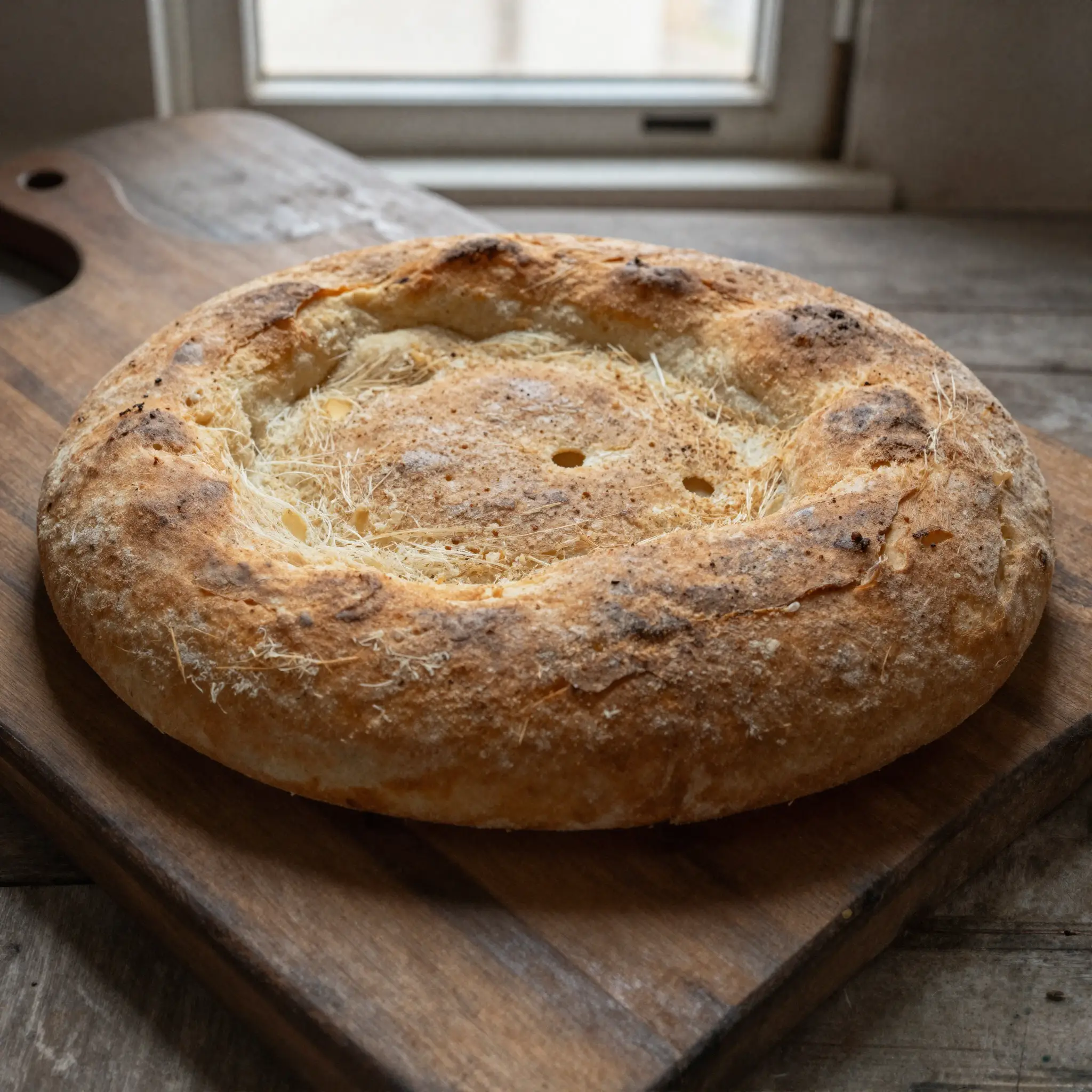
Dabo (Ethiopian fermented wheat bread)
Bread/staple
Facts
| Category | Grain / Legume |
|---|---|
| Product family | Fermented Leavened Wheat Bread |
| Origin | 🇪🇹 Ethiopia |
| Key microorganisms | lactic-acid-bacteria, yeasts |
Safety
- Documented considerations (honest, grain-staple-appropriate):
(a) Dabo relies on a back-slopped or wild-fermented leaven with no single confirmed commercial starter culture documented in our sources, so adequate acidification and visible leavening activity (dough rise, sour aroma) are the primary indicators of a safely proceeding ferment rather than a static, unfermented dough;
(b) mould growth or a markedly putrid/off odour on the dough or leaven (as opposed to the expected mild, slightly sour bread-dough aroma) signals spoilage — such dough should be discarded, not baked;
(c) the dough is baked after fermenting, a high-temperature step that is independently pathogen-inhibitory regardless of the fermentation stage's own safety profile, mirroring the same terminal-bake safety logic as base Sourdough Bread;
(d) as with any cereal-based ferment, mycotoxin/mould awareness for the raw flour itself is a general, honest consideration — wheat flour, like any cereal product, should be sourced from reputable suppliers and stored dry to avoid mould growth prior to use; no specific mycotoxin threshold is asserted, as none is documented;
(e) potable water must be used throughout. Safe-practice guidance: use clean equipment and potable water; maintain leaven/starter hygiene (clean vessel, regular feeding if back-slopping); discard any dough or leaven showing mould growth or a clearly putrid off-odour; store flour dry and from a reputable source; bake thoroughly to the standard internal doneness of a wheat loaf. No specific pH figures, fermentation-duration numerics, bake temperatures, or mycotoxin thresholds are asserted — any such figure is illustrative or not established.
Method
Dabo (Ethiopian Fermented Wheat Bread)
- Wheat flour — ~500 g
- Water — ~300 mL, potable
- Salt — ~8–10 g (illustrative), household-variable, non-safety
- Leaven: either a back-slopped portion (~50–100 g) of a previous Dabo dough, or a spontaneously wild-fermented flour-water starter maintained per household custom (quantities illustrative)
- 1
Step 1
Combine wheat flour, water, and the leaven (back-slopped dough or wild starter) in a clean, non-reactive bowl.
- 2
Step 2
Knead into a smooth dough; add salt.
- 3
Step 3
Cover the dough (not airtight) and leave to bulk-ferment at ambient temperature, allowing LAB to sour the dough while co-resident wild yeasts generate CO2 for leavening.
- 4
Step 4
Check periodically: the dough should visibly rise and develop a mildly sour aroma (duration illustrative, tradition/household-variable, not specified in our sources — typically several hours to overnight by general bread-fermentation practice).
- 5
Step 5
Once adequately risen and sour-aromatic, shape into a round loaf.
- 6
Step 6
Proof the shaped loaf briefly at ambient temperature.
- 7
Step 7
Bake thoroughly in a hot oven until well-risen and cooked through (a safety-relevant heat step, in addition to being the defining cooking stage).
- 8
Step 8
Cool before slicing/serving.
Frequently asked questions
- What is Dabo (Ethiopian fermented wheat bread)?
- Bread/staple
- Which microorganisms ferment Dabo (Ethiopian fermented wheat bread)?
- Dabo (Ethiopian fermented wheat bread) is primarily driven by lactic-acid-bacteria, yeasts.
- Where does Dabo (Ethiopian fermented wheat bread) come from?
- Dabo (Ethiopian fermented wheat bread) is traditionally made in Ethiopia.
- Is Dabo (Ethiopian fermented wheat bread) safe to make at home?
- Documented considerations (honest, grain-staple-appropriate):
(a) Dabo relies on a back-slopped or wild-fermented leaven with no single confirmed commercial starter culture documented in our sources, so adequate acidification and visible leavening activity (dough rise, sour aroma) are the primary indicators of a safely proceeding ferment rather than a static, unfermented dough;
(b) mould growth or a markedly putrid/off odour on the dough or leaven (as opposed to the expected mild, slightly sour bread-dough aroma) signals spoilage — such dough should be discarded, not baked;
(c) the dough is baked after fermenting, a high-temperature step that is independently pathogen-inhibitory regardless of the fermentation stage's own safety profile, mirroring the same terminal-bake safety logic as base Sourdough Bread;
(d) as with any cereal-based ferment, mycotoxin/mould awareness for the raw flour itself is a general, honest consideration — wheat flour, like any cereal product, should be sourced from reputable suppliers and stored dry to avoid mould growth prior to use; no specific mycotoxin threshold is asserted, as none is documented;
(e) potable water must be used throughout. Safe-practice guidance: use clean equipment and potable water; maintain leaven/starter hygiene (clean vessel, regular feeding if back-slopping); discard any dough or leaven showing mould growth or a clearly putrid off-odour; store flour dry and from a reputable source; bake thoroughly to the standard internal doneness of a wheat loaf. No specific pH figures, fermentation-duration numerics, bake temperatures, or mycotoxin thresholds are asserted — any such figure is illustrative or not established.
Community results
No community results published for this ferment yet.