
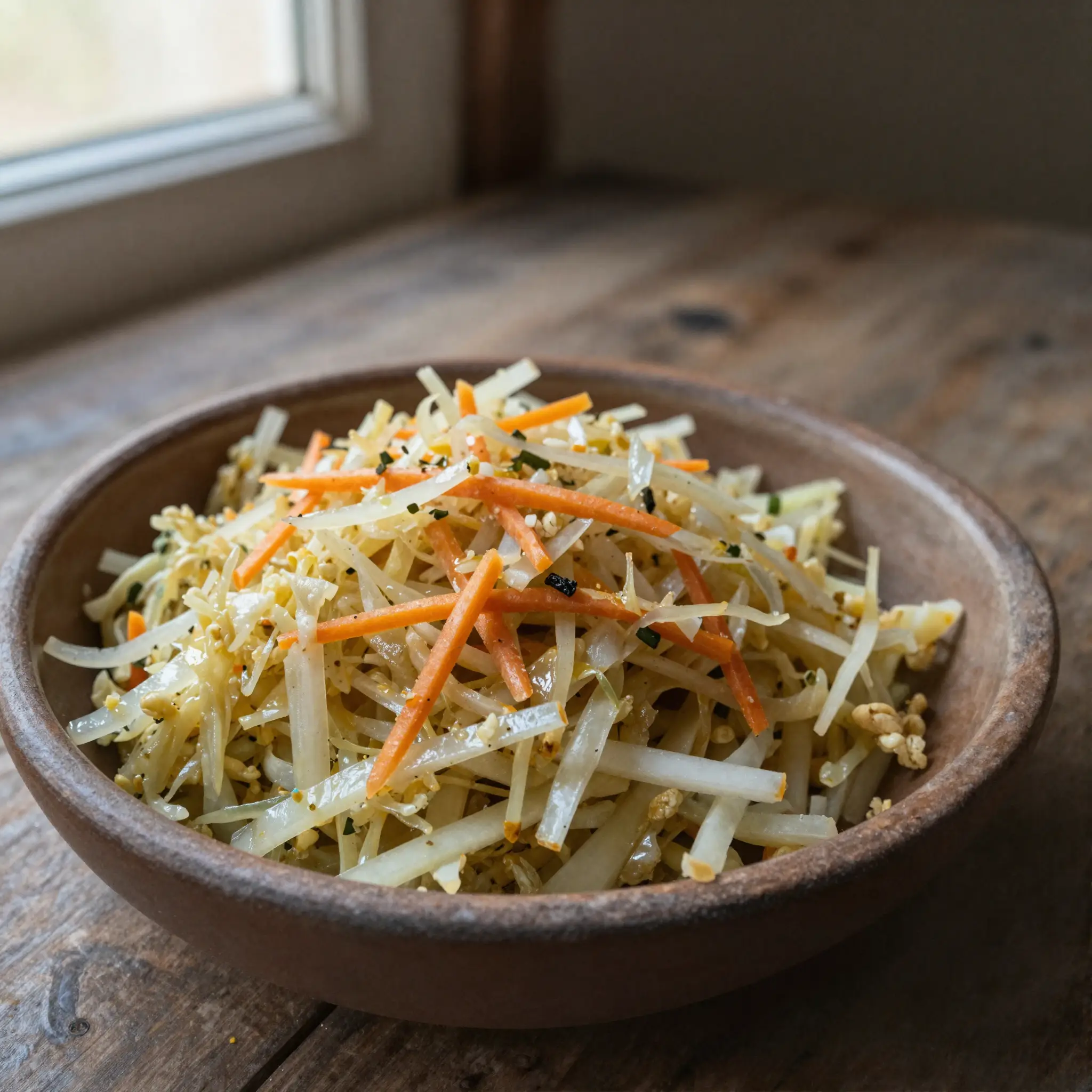
Curtido (Salvadoran fermented cabbage-carrot-onion slaw)
Curtido (El Salvador / Central American lacto-fermented cabbage-carrot-onion slaw)
vegetable-ferment-pickle
Facts
| Category | Vegetable |
|---|---|
| Product family | Fermented Cabbage |
| Origin | 🇸🇻 El Salvador |
Safety
- Same core anaerobic/salinity-floor logic as sauerkraut and kiselo zele, inherited by analogy for this shredded-brassica, light-brine sub-style. Documented risk factor — insufficient brine salinity, or shredded vegetable left exposed above the brine line, permits spoilage organisms and, in a fully anaerobic low-acid pocket before acidification, a theoretical Clostridium botulinum concern; this risk is somewhat elevated relative to sauerkraut because curtido's shorter, lighter-brine tradition gives less of a salinity/acidification safety margin, and this should be stated honestly rather than downplayed. Safe-practice guidance:
(a) use an adequate salt concentration even for the lighter, shorter brine tradition (~2% by weight is the illustrative home figure cited for this lighter style; precise regulatory-grade floors are recipe-specific and not separately confirmed for this specific product — do not treat as a hard number);
(b) keep all shredded solids fully submerged below the brine/liquid line;
(c) target pH ≤4.6 before treating the product as shelf-stable at room temperature; if serving before that point is reached, treat it and refrigerate as a fresh, perishable slaw rather than a finished ferment;
(d) discard on fuzzy surface mould, putrid (not sour) odour, or sliminess;
(e) do not seal into a shelf-stable, non-refrigerated low-acid state without a validated canning process.
Method
Curtido (El Salvador / Central American Lightly Fermented Cabbage-Carrot-Onion Slaw)
- White cabbage, finely shredded — ~1000 g
- Carrot, shredded/julienned — ~150 g
- White onion, thinly sliced — ~100 g
- Dried oregano — ~1–2 tsp
- Chili (fresh or dried, e.g. chile de árbol), to taste — optional (flavour, non-safety)
- Non-iodized salt — quantity to make a ~2% brine (illustrative), plus a small amount for the initial dry-salt/massage step — SAFETY CONTROL, see linked Variant
- Water — enough to fully submerge (~500 ml–1 L, depending on how much liquid the salted vegetables release)
- Optional: a splash of vinegar, added only at serving as a flavour finish, not as part of the fermentation
- 1
Step 1
Shred cabbage finely; shred/julienne carrot; thinly slice onion.
- 2
Step 2
Combine cabbage, carrot, onion, and oregano in a large bowl.
- 3
Step 3
Add chili if using.
- 4
Step 4
Salt the mixture and massage or firmly pack it to help draw out liquid.
- 5
Step 5
Pack the salted vegetables tightly into a clean jar, pressing down to release trapped air.
- 6
Step 6
If the vegetables' own drawn liquid does not fully cover them, top up with a light salt brine to submerge fully.
- 7
Step 7
Weight or wedge the vegetables so everything stays below the liquid line.
- 8
Step 8
Cover with a breathable lid; ferment at ambient temperature.
- 9
Step 9
Check daily: confirm submersion; skim any surface film.
- 10
Step 10
Taste from ~3 days onward; continue to desired sourness (typically 3 days to about a week).
- 11
Step 11
Refrigerate once at target flavour. Optionally stir in a splash of vinegar at serving, as a flavour finish only.
- 12
Step 12
Serve chilled, classically as a topping for pupusas.
Frequently asked questions
- What is Curtido (Salvadoran fermented cabbage-carrot-onion slaw)?
- vegetable-ferment-pickle
- Where does Curtido (Salvadoran fermented cabbage-carrot-onion slaw) come from?
- Curtido (Salvadoran fermented cabbage-carrot-onion slaw) is traditionally made in El Salvador.
- Is Curtido (Salvadoran fermented cabbage-carrot-onion slaw) safe to make at home?
- Same core anaerobic/salinity-floor logic as sauerkraut and kiselo zele, inherited by analogy for this shredded-brassica, light-brine sub-style. Documented risk factor — insufficient brine salinity, or shredded vegetable left exposed above the brine line, permits spoilage organisms and, in a fully anaerobic low-acid pocket before acidification, a theoretical Clostridium botulinum concern; this risk is somewhat elevated relative to sauerkraut because curtido's shorter, lighter-brine tradition gives less of a salinity/acidification safety margin, and this should be stated honestly rather than downplayed. Safe-practice guidance:
(a) use an adequate salt concentration even for the lighter, shorter brine tradition (~2% by weight is the illustrative home figure cited for this lighter style; precise regulatory-grade floors are recipe-specific and not separately confirmed for this specific product — do not treat as a hard number);
(b) keep all shredded solids fully submerged below the brine/liquid line;
(c) target pH ≤4.6 before treating the product as shelf-stable at room temperature; if serving before that point is reached, treat it and refrigerate as a fresh, perishable slaw rather than a finished ferment;
(d) discard on fuzzy surface mould, putrid (not sour) odour, or sliminess;
(e) do not seal into a shelf-stable, non-refrigerated low-acid state without a validated canning process.
Community results
No community results published for this ferment yet.