
Meat / Fish
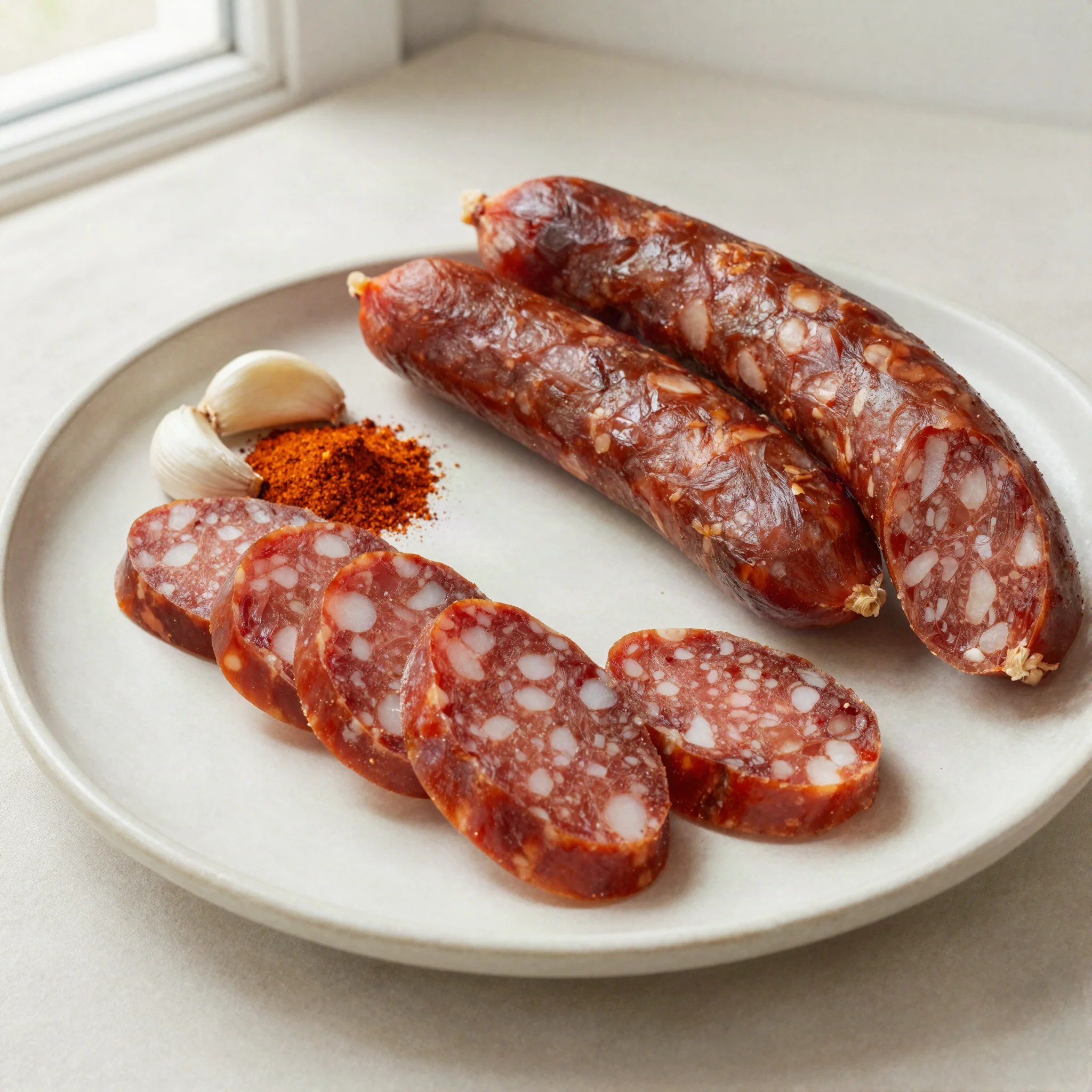
Chorizo (Spanish dry-cured fermented sausage)
Meat ferment/sausage
Facts
| Category | Meat / Fish |
|---|---|
| Product family | Iberian Dry Fermented Sausage |
| Key microorganisms | lactic-acid-bacteria, halophilic-other |
Safety
- Full fermented-meat hazard profile:
(a) Clostridium botulinum — curing salts + prompt acidification + drying are the combined hurdle; home production without them carries a genuine, potentially fatal risk.
(b) STEC/E. coli O157:H7 — documented in dry fermented sausage; raw-material hygiene decisive.
(c) Listeria monocytogenes — dry chorizo is ready-to-eat.
(d) Staphylococcus aureus toxin — when acidification stalls.
(e) Trichinella/parasites — pork product; inspected supply and regulated freezing/heating regimes are the controls.
(f) Biogenic amines over long curing.
(g) Type confusion is itself a safety issue: fresh/cooking chorizo is raw meat and must be cooked; only the dry-cured fermented type is ready-to-eat. Do not treat the two as interchangeable.
(h) Surface mould: a benign bloom may appear on long-cured pieces; atypical green/black/fuzzy growth means discard. Safe-practice guidance: use inspected pork; use curing salts exactly per directions; keep cold until fermentation; ensure acidification proceeds promptly; dry in a cool ventilated space; never eat a fresh/cooking-type chorizo without cooking it; discard product with off-odours, sliminess or atypical mould. Numerics. Presented in two registers, and every figure carries the jurisdiction it comes from. ① Commercial-standard numerics — what a regulated product must meet. Informational. These are not instructions to a home fermenter. - Nitrite, maximum added: 150 mg/kg. European Union, Directive 2006/52/EC, for dried fermented meat products; products with a long ripening period and no nitrite may carry up to 250 mg/kg nitrate. The United States sets a closely comparable 156 mg/kg ingoing sodium nitrite for comminuted product under 9 CFR 424.21(c), which also caps the finished product at 200 ppm. Two jurisdictions drafting separately land within a few per cent of each other. - This is an added (ingoing) limit. Residual nitrite measured in a finished sausage is a different and much smaller quantity, and must never be read as a dose. - Clostridium botulinum control. The FSIS ready-to-eat fermented, salt-cured and dried products guideline (United States, May 2023) records that 50 ppm sodium nitrite or a water activity of 0.92 or below is sufficient to prevent growth in this class of product, and that at least 100 ppm nitrite or nitrate together with at least 2.5 % salt can also be used to control it during fermentation and drying. - Shelf stability. Fermented or pickled to pH 4.6 or below, or dried to a water activity of 0.92 or below (same guideline). - Pathogen reduction targets (United States, guidance not law): 5-log reduction for Salmonella and STEC, 3-log for Listeria monocytogenes; for Staphylococcus aureus, no more than 2-log growth during production and no outgrowth in storage. - Degree-hours exist to limit Staphylococcus aureus growth during fermentation. Degrees are counted as the excess over 60 °F (15.6 °C), the temperature at which staphylococcal growth begins, and the permitted total depends on the highest temperature reached before pH 5.3 is attained. The numeric caps live in a separate good-manufacturing-practice document that has not been retrieved, so no degree-hour number is published here. ② Home-scale guidance — actionable. - This is not a beginner product, and that is a sourced statement, not caution for its own sake. The FSIS guideline says plainly that fermentation and drying alone do not generally achieve the pathogen reductions it recommends; commercial producers reach them by adding interventions such as a higher fermentation temperature with a low final pH, a low-temperature heat step before drying, or longer drying at a maintained low pH. A dry fermented sausage made at home without a validated process does not carry the same assurance. - Curing salt is a safety control and is not interchangeable with plain salt. The legal figures above are for sodium nitrite itself, not for the packet in your hand. Curing-salt products differ enormously in strength — a common cure sold at 6.25 % nitrite needs about 2.4 g per kg of meat to reach 150 mg/kg, while a nitrited curing salt at 0.4–0.5 % needs roughly 30–38 g per kg for the same result. Dose from the nitrite percentage declared on your own product, never from a remembered gram figure. - Worked example, 6.25 % cure: 150 mg/kg divided by 0.0625 gives 2.4 g of cure per kg, so 5 kg of meat takes about 12 g of cure, delivering 0.75 g of actual sodium nitrite. Treat 150 mg/kg as a ceiling, not a target to aim past. - Even distribution matters as much as the dose. A correctly weighed cure that is unevenly mixed leaves under-protected pockets. Still not established: the numeric degree-hour caps; product-specific pH ceilings, water-activity floors and ripening durations, none of which any retrieved instrument sets for this product by name.
Method
Chorizo (Spanish dry-cured fermented sausage)
- Pork — lean ~800 g · fat — ~200 g (illustrative)
- Salt — SAFETY CONTROL — ~25 g per kg (2.5 %) (see the 2.5 % floor note in the linked Variant)
- Curing salts (nitrite) — SAFETY CONTROL. Dose to the legal ceiling of 150 mg/kg added sodium nitrite (EU Directive 2006/52/EC; US 9 CFR 424.21(c) sets a comparable 156 mg/kg), never above it. Calculate from the nitrite percentage printed on your own product, because cure strength varies about tenfold between products: a 6.25 % cure needs ~2.4 g per kg of meat; a nitrited curing salt at 0.4–0.5 % needs ~30–38 g per kg. Not interchangeable with plain salt. Mix in thoroughly — uneven distribution leaves under-protected pockets.
- Pimentón (Spanish smoked or sweet paprika) — the defining seasoning, used generously: dulce ~20 g, picante ~5 g (illustrative)
- Garlic — ~10 g (illustrative)
- Natural casings — ~1.5 m of 38–40 mm (illustrative)
- (optional) Defined starter culture
- 1
Step 1
Chill and chop/grind the pork and fat to the style's texture.
- 2
Step 2
Mix thoroughly with salt, curing salts, pimentón and garlic.
- 3
Step 3
Rest under refrigeration so the cure and paprika penetrate the batter.
- 4
Step 4
Stuff into casings and tie into the style's shape (sarta horseshoe, vela straight, ristra linked).
- 5
Step 5
Fermentation stage: hold under controlled conditions until acidified. (Parameters: not established.)
- 6
Step 6
Air-drying/curing: hang in a cool, ventilated space for weeks to months until firm; some regional styles are smoked during or after this stage.
- 7
Step 7
Store and serve as ready-to-eat, sliced.
Frequently asked questions
- What is Chorizo (Spanish dry-cured fermented sausage)?
- Meat ferment/sausage
- Which microorganisms ferment Chorizo (Spanish dry-cured fermented sausage)?
- Chorizo (Spanish dry-cured fermented sausage) is primarily driven by lactic-acid-bacteria, halophilic-other.
- Is Chorizo (Spanish dry-cured fermented sausage) safe to make at home?
- Full fermented-meat hazard profile:
(a) Clostridium botulinum — curing salts + prompt acidification + drying are the combined hurdle; home production without them carries a genuine, potentially fatal risk.
(b) STEC/E. coli O157:H7 — documented in dry fermented sausage; raw-material hygiene decisive.
(c) Listeria monocytogenes — dry chorizo is ready-to-eat.
(d) Staphylococcus aureus toxin — when acidification stalls.
(e) Trichinella/parasites — pork product; inspected supply and regulated freezing/heating regimes are the controls.
(f) Biogenic amines over long curing.
(g) Type confusion is itself a safety issue: fresh/cooking chorizo is raw meat and must be cooked; only the dry-cured fermented type is ready-to-eat. Do not treat the two as interchangeable.
(h) Surface mould: a benign bloom may appear on long-cured pieces; atypical green/black/fuzzy growth means discard. Safe-practice guidance: use inspected pork; use curing salts exactly per directions; keep cold until fermentation; ensure acidification proceeds promptly; dry in a cool ventilated space; never eat a fresh/cooking-type chorizo without cooking it; discard product with off-odours, sliminess or atypical mould. Numerics. Presented in two registers, and every figure carries the jurisdiction it comes from. ① Commercial-standard numerics — what a regulated product must meet. Informational. These are not instructions to a home fermenter. - Nitrite, maximum added: 150 mg/kg. European Union, Directive 2006/52/EC, for dried fermented meat products; products with a long ripening period and no nitrite may carry up to 250 mg/kg nitrate. The United States sets a closely comparable 156 mg/kg ingoing sodium nitrite for comminuted product under 9 CFR 424.21(c), which also caps the finished product at 200 ppm. Two jurisdictions drafting separately land within a few per cent of each other. - This is an added (ingoing) limit. Residual nitrite measured in a finished sausage is a different and much smaller quantity, and must never be read as a dose. - Clostridium botulinum control. The FSIS ready-to-eat fermented, salt-cured and dried products guideline (United States, May 2023) records that 50 ppm sodium nitrite or a water activity of 0.92 or below is sufficient to prevent growth in this class of product, and that at least 100 ppm nitrite or nitrate together with at least 2.5 % salt can also be used to control it during fermentation and drying. - Shelf stability. Fermented or pickled to pH 4.6 or below, or dried to a water activity of 0.92 or below (same guideline). - Pathogen reduction targets (United States, guidance not law): 5-log reduction for Salmonella and STEC, 3-log for Listeria monocytogenes; for Staphylococcus aureus, no more than 2-log growth during production and no outgrowth in storage. - Degree-hours exist to limit Staphylococcus aureus growth during fermentation. Degrees are counted as the excess over 60 °F (15.6 °C), the temperature at which staphylococcal growth begins, and the permitted total depends on the highest temperature reached before pH 5.3 is attained. The numeric caps live in a separate good-manufacturing-practice document that has not been retrieved, so no degree-hour number is published here. ② Home-scale guidance — actionable. - This is not a beginner product, and that is a sourced statement, not caution for its own sake. The FSIS guideline says plainly that fermentation and drying alone do not generally achieve the pathogen reductions it recommends; commercial producers reach them by adding interventions such as a higher fermentation temperature with a low final pH, a low-temperature heat step before drying, or longer drying at a maintained low pH. A dry fermented sausage made at home without a validated process does not carry the same assurance. - Curing salt is a safety control and is not interchangeable with plain salt. The legal figures above are for sodium nitrite itself, not for the packet in your hand. Curing-salt products differ enormously in strength — a common cure sold at 6.25 % nitrite needs about 2.4 g per kg of meat to reach 150 mg/kg, while a nitrited curing salt at 0.4–0.5 % needs roughly 30–38 g per kg for the same result. Dose from the nitrite percentage declared on your own product, never from a remembered gram figure. - Worked example, 6.25 % cure: 150 mg/kg divided by 0.0625 gives 2.4 g of cure per kg, so 5 kg of meat takes about 12 g of cure, delivering 0.75 g of actual sodium nitrite. Treat 150 mg/kg as a ceiling, not a target to aim past. - Even distribution matters as much as the dose. A correctly weighed cure that is unevenly mixed leaves under-protected pockets. Still not established: the numeric degree-hour caps; product-specific pH ceilings, water-activity floors and ripening durations, none of which any retrieved instrument sets for this product by name.
Community results
No community results published for this ferment yet.