
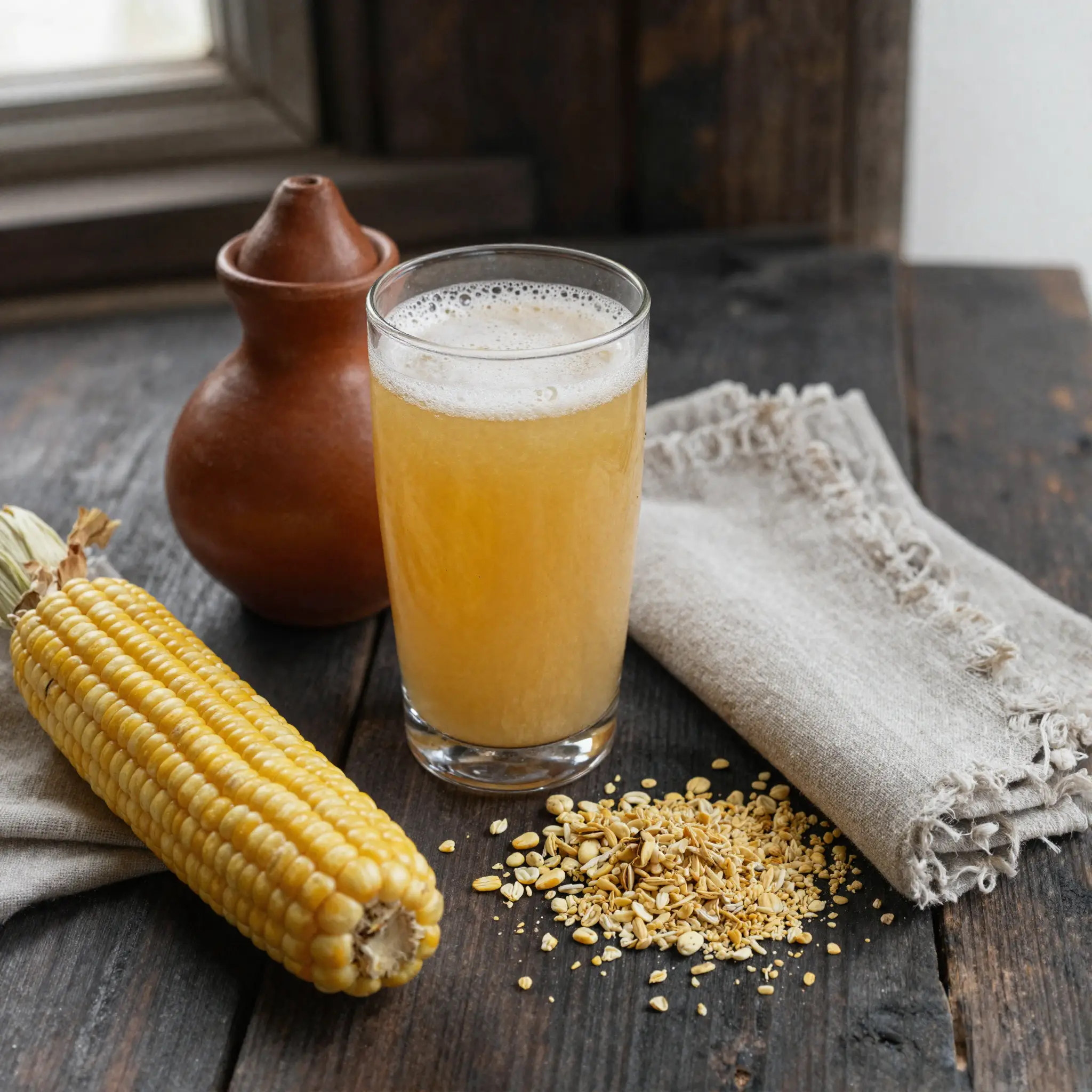
Chicha de Jora
Alcoholic beverage
Facts
| Category | Grain / Legume |
|---|---|
| Origin | 🇵🇪 Peru |
Safety
- No significant acute-hazard risk factors documented for traditionally-prepared chicha de jora using the malting/mashing method described above. Safe-practice guidance:
(a) the malting-and-boiling sequence provides meaningful built-in safety margins analogous to beer production — the boiling step in particular is pathogen-inhibitory independent of the subsequent fermentation;
(b) chicha de jora's malted-grain method (documented here) is distinct from other chicha-family beverages made via chewing/salivary-amylase saccharification (documented as a historically-attested alternative method for some chicha and related Latin American maize-beer traditions) — the two methods carry potentially different hygiene profiles (chewing introduces human oral microbiota as a deliberate saccharification mechanism, a practice with its own traditional-safety track record but a categorically different hygiene consideration than malting) and should not be conflated as a single undifferentiated "chicha" safety statement; this Variant entry covers the malted-jora method specifically;
(c) as with pulque, fresh/prompt consumption is traditionally emphasized over extended storage.
Method
Chicha de Jora (Malted-Maize Fermented Beverage)
- Maize kernels, for malting into jora — 2 kg, illustrative
- Water — for germination, mashing, and the ferment
- Back-slop from a previous chicha — illustrative; optional
- Optional: chancaca/unrefined sugar (illustrative; traditional in some styles)
- 1
Step 1
Soak the maize kernels, then keep them moist and warm to germinate them — this is the malting step, and it activates the maize's own amylase enzymes.
- 2
Step 2
Let them germinate until sprouted; this produces jora.
- 3
Step 3
Dry the sprouted maize thoroughly.
- 4
Step 4
Mill the dried jora coarsely.
- 5
Step 5
Mash: steep the milled jora in hot water so its activated enzymes convert the starch into fermentable sugar. This is the step the whole recipe turns on — this is a malted, not a chewed, chicha. (Some traditional chichas instead use salivary amylase from chewing to saccharify the maize; chicha de jora is specifically the malted method, and the linked Variant records that distinction — do not conflate the two.)
- 6
Step 6
Boil the resulting liquid, then strain out the solids.
- 7
Step 7
Cool it to ambient temperature.
- 8
Step 8
Transfer to a fermentation vessel and add the back-slop, if using; otherwise let ambient wild yeast start it.
- 9
Step 9
Ferment at ambient temperature for several days, until sour and mildly alcoholic.
- 10
Step 10
Strain and serve fresh; like pulque, chicha is a young, living drink that continues to change.
Frequently asked questions
- What is Chicha de Jora?
- Alcoholic beverage
- Where does Chicha de Jora come from?
- Chicha de Jora is traditionally made in Peru.
- Is Chicha de Jora safe to make at home?
- No significant acute-hazard risk factors documented for traditionally-prepared chicha de jora using the malting/mashing method described above. Safe-practice guidance:
(a) the malting-and-boiling sequence provides meaningful built-in safety margins analogous to beer production — the boiling step in particular is pathogen-inhibitory independent of the subsequent fermentation;
(b) chicha de jora's malted-grain method (documented here) is distinct from other chicha-family beverages made via chewing/salivary-amylase saccharification (documented as a historically-attested alternative method for some chicha and related Latin American maize-beer traditions) — the two methods carry potentially different hygiene profiles (chewing introduces human oral microbiota as a deliberate saccharification mechanism, a practice with its own traditional-safety track record but a categorically different hygiene consideration than malting) and should not be conflated as a single undifferentiated "chicha" safety statement; this Variant entry covers the malted-jora method specifically;
(c) as with pulque, fresh/prompt consumption is traditionally emphasized over extended storage.
Community results
No community results published for this ferment yet.