
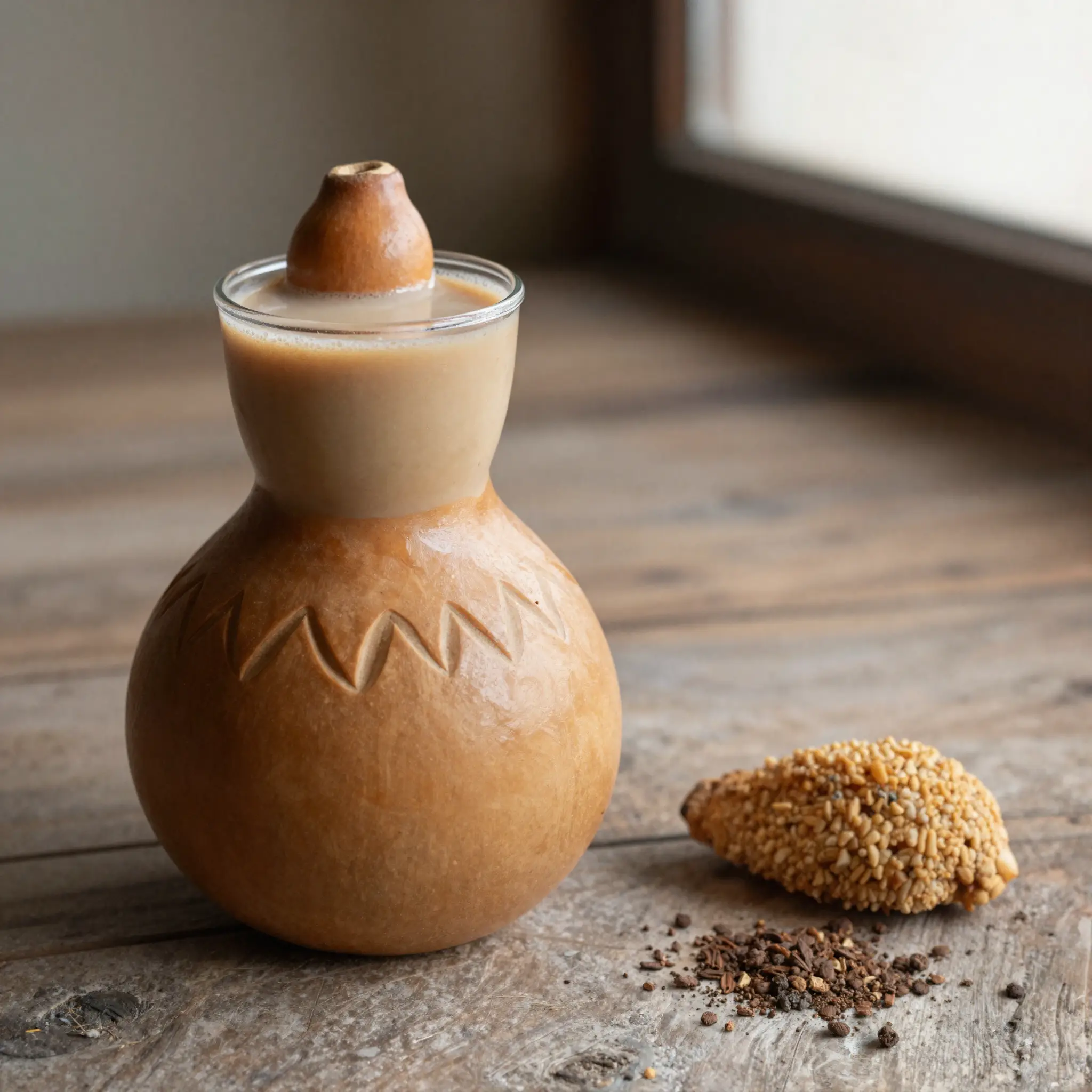
Borde (Ethiopian fermented maize/sorghum/finger-millet beverage)
Beverage
Facts
| Category | Grain / Legume |
|---|---|
| Product family | Fermented Multi-Grain Beverage |
| Origin | 🇪🇹 Ethiopia |
| Key microorganisms | lactic-acid-bacteria, yeasts |
Safety
- This entry is explicitly flagged as thin evidence (Low confidence) — no Borde-specific safety literature is available in the reviewed source base. Documented considerations, stated honestly at the general level applicable to any spontaneous/back-slopped mixed lactic+yeast grain beverage (by analogy to Mahewu, Kvass, and other documented spontaneous grain ferments, not as Borde-specific sourced findings):
(a) a genuinely fermented, adequately acidified batch (sour taste/aroma, some visible activity) is the general indicator that a spontaneous or back-slopped grain-beverage fermentation has proceeded as intended, as opposed to an unfermented or under-fermented batch;
(b) mould growth or a markedly putrid/off odour would, by general food-fermentation-safety principle, signal spoilage requiring discard, though this is not independently confirmed as a Borde-specific finding;
(c) the mild alcohol content disclosed in the source should be disclosed to consumers avoiding alcohol, per the same boundary-note discipline applied to Kvass and other mixed-sequential beverages;
(d) potable water should be used throughout, as a general food-safety principle, not a Borde-specific sourced requirement;
(e) if fermented in a sealed vessel, incidental yeast-driven CO2 production could in principle create pressure-buildup risk, by the same general mechanical logic applied to other mixed lactic+yeast beverages in this sub-batch — again, a general-principle note, not a Borde-specific confirmed finding. Safe-practice guidance (general-principle, explicitly not Borde-specific): use clean equipment and potable water; avoid sealed/airtight fermentation vessels; discard any batch showing mould or clearly putrid off-odour; disclose the mild alcohol content where relevant. No specific pathogen thresholds, pH figures, alcohol percentages, or duration numerics are asserted for Borde — this entire safety statement is explicitly lower-confidence than the Mahewu and Kvass statements above and should not be treated as equivalent in evidentiary weight.
Method
Borde (Ethiopian Fermented Maize/Sorghum/Finger-Millet Beverage) — Low confidence, thin evidence flagged
- Maize, sorghum, and finger millet (multi-grain substrate, per our sources' listing) — proportions not established (not specified in our sources; no illustrative split is invented)
- Water — quantity not established
- Starter: not established whether back-slop, spontaneous, or another mechanism is traditionally used; recorded provisionally as spontaneous-or-back-slopped by analogy only (see linked Variant item 6)
- 1
Step 1
The grains are plausibly cooked and/or malted and combined with water into a gruel or mash (analogy-based, not confirmed for Borde specifically).
- 2
Step 2
The mash is plausibly cooled and left to ferment — via spontaneous or back-slopped inoculation — at ambient temperature (analogy-based).
- 3
Step 3
LAB and yeast activity plausibly proceed concurrently, contributing the lactic and mild-alcoholic components the source documents for the finished product (analogy-based).
- 4
Step 4
The fermented beverage is plausibly strained and consumed (analogy-based). This four-step sequence is a Low-confidence reconstruction only, explicitly not a verified Borde process — treat as a placeholder pending a dedicated Ethiopian/East African fermentation-literature sourcing pass, not as an authoritative recipe.
Frequently asked questions
- What is Borde (Ethiopian fermented maize/sorghum/finger-millet beverage)?
- Beverage
- Which microorganisms ferment Borde (Ethiopian fermented maize/sorghum/finger-millet beverage)?
- Borde (Ethiopian fermented maize/sorghum/finger-millet beverage) is primarily driven by lactic-acid-bacteria, yeasts.
- Where does Borde (Ethiopian fermented maize/sorghum/finger-millet beverage) come from?
- Borde (Ethiopian fermented maize/sorghum/finger-millet beverage) is traditionally made in Ethiopia.
- Is Borde (Ethiopian fermented maize/sorghum/finger-millet beverage) safe to make at home?
- This entry is explicitly flagged as thin evidence (Low confidence) — no Borde-specific safety literature is available in the reviewed source base. Documented considerations, stated honestly at the general level applicable to any spontaneous/back-slopped mixed lactic+yeast grain beverage (by analogy to Mahewu, Kvass, and other documented spontaneous grain ferments, not as Borde-specific sourced findings):
(a) a genuinely fermented, adequately acidified batch (sour taste/aroma, some visible activity) is the general indicator that a spontaneous or back-slopped grain-beverage fermentation has proceeded as intended, as opposed to an unfermented or under-fermented batch;
(b) mould growth or a markedly putrid/off odour would, by general food-fermentation-safety principle, signal spoilage requiring discard, though this is not independently confirmed as a Borde-specific finding;
(c) the mild alcohol content disclosed in the source should be disclosed to consumers avoiding alcohol, per the same boundary-note discipline applied to Kvass and other mixed-sequential beverages;
(d) potable water should be used throughout, as a general food-safety principle, not a Borde-specific sourced requirement;
(e) if fermented in a sealed vessel, incidental yeast-driven CO2 production could in principle create pressure-buildup risk, by the same general mechanical logic applied to other mixed lactic+yeast beverages in this sub-batch — again, a general-principle note, not a Borde-specific confirmed finding. Safe-practice guidance (general-principle, explicitly not Borde-specific): use clean equipment and potable water; avoid sealed/airtight fermentation vessels; discard any batch showing mould or clearly putrid off-odour; disclose the mild alcohol content where relevant. No specific pathogen thresholds, pH figures, alcohol percentages, or duration numerics are asserted for Borde — this entire safety statement is explicitly lower-confidence than the Mahewu and Kvass statements above and should not be treated as equivalent in evidentiary weight.
Community results
No community results published for this ferment yet.