
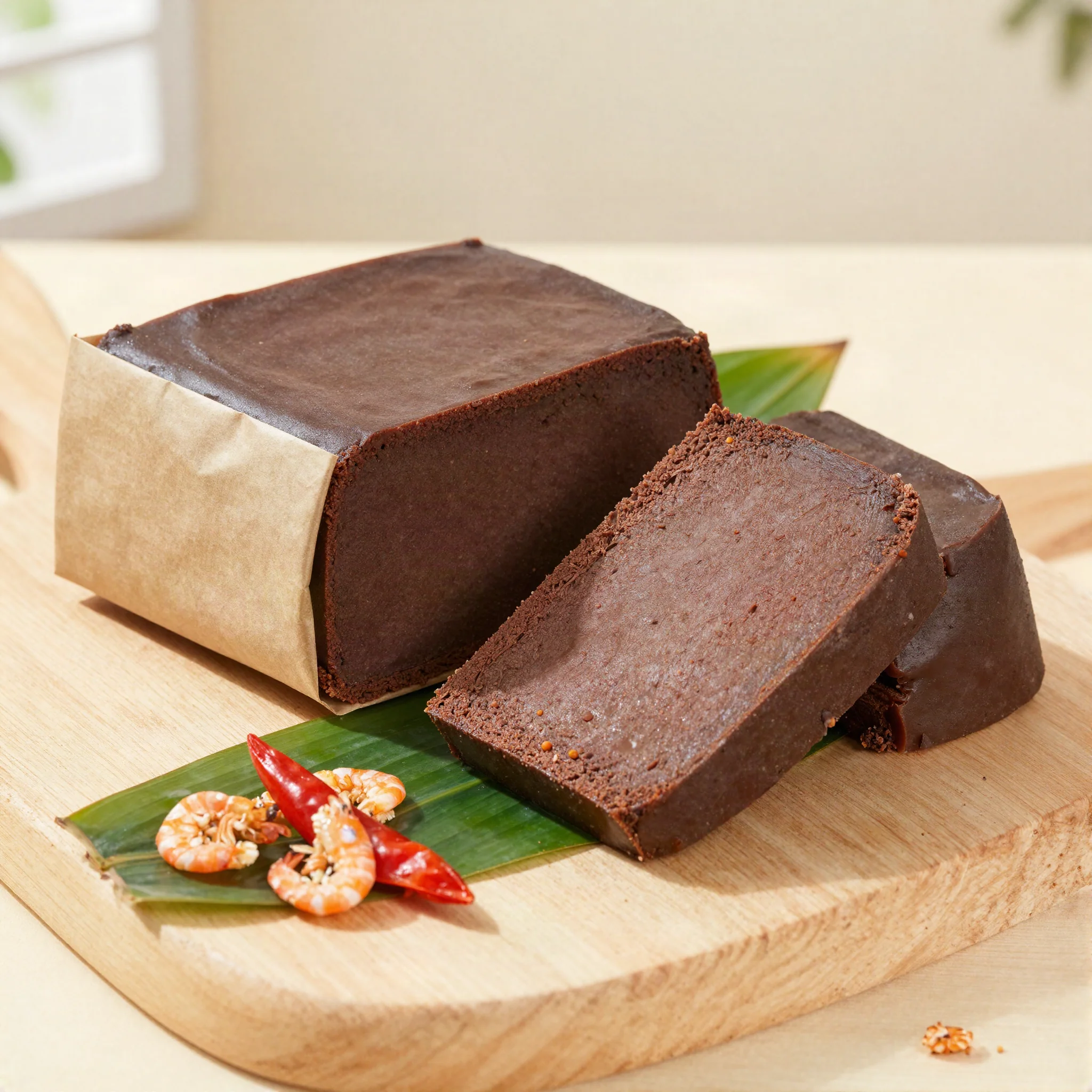
Belacan / Terasi
Belacan / Terasi (Malaysian–Indonesian fermented shrimp paste)
Condiment/paste
Facts
| Category | Meat / Fish |
|---|---|
| Product family | Southeast Asian Shrimp Paste |
| Origin | 🇮🇩 Indonesia |
| Key microorganisms | halophilic-other |
Safety
- Salt concentration is the primary preservation control and under-salting is the central failure mode — salt is the barrier across an extended ambient ferment of raw crustacean protein. Documented risk factors:
(a) CRUSTACEAN / SHELLFISH ALLERGEN — governing hazard for this product. Belacan/terasi is concentrated krill. It is used invisibly — pounded into sambal, curry pastes and dipping sauces — so a shellfish-allergic person frequently cannot see or taste that it is present, and reactions can be severe. Always declare it; treat any Southeast Asian sambal or curry paste as shrimp-paste-containing unless confirmed otherwise.
(b) Histamine and other biogenic amines — the defining hazard of fermented seafood. Bacteria decarboxylate free amino acids into histamine during the long ferment and storage; histamine is heat-stable and is NOT destroyed by cooking, so the traditional toasting step and later cooking do not remove it. Control is upstream: genuinely fresh krill, salted promptly, never temperature-abused.
(c) Clostridium botulinum type E — fish/seafood-associated and cold-tolerant, able to grow at refrigeration temperatures other types cannot, in packed anaerobic salted seafood. Adequate salt is the hurdle; the repeated sun-drying that lowers available water is a second, complementary one. Under-salted, sealed, wet product removes both.
(d) Parasites — raw crustaceans carry parasite risk; salting, fermentation and sun-drying are not validated kill steps, and the product is conventionally toasted and cooked.
(e) Listeria monocytogenes and Salmonella — handling hazards of raw seafood and of a ready-to-use condiment: clean equipment and hands, no cross-contamination between raw krill and finished paste, and protection from insects, birds and dust during the open-air sun-drying stage — this product's distinctive exposure point.
(f) Spoilage/putrefaction — an under-salted batch putrefies rather than ferments; slime, mould, discoloration or off-odour beyond the normal pungency means discard. Safe-practice guidance: use genuinely fresh krill and salt promptly; hold the traditional high salt proportion throughout; protect the mass while sun-drying; store finished blocks tightly wrapped and dry; declare the crustacean allergen whenever the paste is used for others; discard spoiled batches. Do not reduce the salt to make it milder. Numerics: no salt percentage, histamine ppm, pH value, drying temperature or cycle duration is asserted — (illustrative) / not established.
Method
Belacan / Terasi (Malaysian–Indonesian fermented shrimp paste)
- Krill / very small shrimp (planktonic coastal krill), whole and unpeeled — ~3 kg (illustrative) — must be genuinely fresh; freshness before salting is a SAFETY CONTROL
- Salt — SAFETY CONTROL — ~1 kg (illustrative; the family convention is 3 parts fish to 1 part salt by weight — the direction matters, it is three times as much fish as salt). This proportion is the sole preservation control across the whole ferment and must not be reduced for palatability.
- Clean drying trays or mats, and clean covers/screens to protect the mass during sun-drying
- Mortar/grinder; moulds or wrappers for forming blocks
- (no starter culture — this ferment is spontaneous)
- Allergen note: a crustacean product, used invisibly in sambal and curry pastes.
- 1
Step 1
Use freshly landed krill. Rinse and drain thoroughly.
- 2
Step 2
Mix with the salt until evenly distributed — even distribution is itself a control point.
- 3
Step 3
Initial fermentation: hold the salted krill packed and covered for an initial period. (Duration: not established.)
- 4
Step 4
Sun-drying: spread the fermented mass to dry in the sun — keep it screened/covered against insects, birds and dust; this open-air stage is the product's distinctive exposure point (SAFETY CONTROL, see linked Variant).
- 5
Step 5
Grinding: pound or grind the partly dried mass to a paste.
- 6
Step 6
Re-fermentation: return the ground paste to ferment.
- 7
Step 7
Repeat steps 4–6 over an extended period. Across the cycles the colour deepens from pink toward purple-brown and the aroma intensifies. (Number of cycles and total duration: not established.)
- 8
Step 8
Forming: press the matured paste into dense blocks or cakes; wrap tightly and store dry.
- 9
Step 9
In the kitchen: break off a piece and toast or dry-fry it before pounding it into sambal, curry/rempah pastes or stir-fries. (Toasting is a flavour step on a finished ferment — it is not part of the fermentation and not a histamine control; see linked Variant.) Declare the crustacean allergen when serving others.
Frequently asked questions
- What is Belacan / Terasi?
- Condiment/paste
- Which microorganisms ferment Belacan / Terasi?
- Belacan / Terasi is primarily driven by halophilic-other.
- Where does Belacan / Terasi come from?
- Belacan / Terasi is traditionally made in Indonesia.
- Is Belacan / Terasi safe to make at home?
- Salt concentration is the primary preservation control and under-salting is the central failure mode — salt is the barrier across an extended ambient ferment of raw crustacean protein. Documented risk factors:
(a) CRUSTACEAN / SHELLFISH ALLERGEN — governing hazard for this product. Belacan/terasi is concentrated krill. It is used invisibly — pounded into sambal, curry pastes and dipping sauces — so a shellfish-allergic person frequently cannot see or taste that it is present, and reactions can be severe. Always declare it; treat any Southeast Asian sambal or curry paste as shrimp-paste-containing unless confirmed otherwise.
(b) Histamine and other biogenic amines — the defining hazard of fermented seafood. Bacteria decarboxylate free amino acids into histamine during the long ferment and storage; histamine is heat-stable and is NOT destroyed by cooking, so the traditional toasting step and later cooking do not remove it. Control is upstream: genuinely fresh krill, salted promptly, never temperature-abused.
(c) Clostridium botulinum type E — fish/seafood-associated and cold-tolerant, able to grow at refrigeration temperatures other types cannot, in packed anaerobic salted seafood. Adequate salt is the hurdle; the repeated sun-drying that lowers available water is a second, complementary one. Under-salted, sealed, wet product removes both.
(d) Parasites — raw crustaceans carry parasite risk; salting, fermentation and sun-drying are not validated kill steps, and the product is conventionally toasted and cooked.
(e) Listeria monocytogenes and Salmonella — handling hazards of raw seafood and of a ready-to-use condiment: clean equipment and hands, no cross-contamination between raw krill and finished paste, and protection from insects, birds and dust during the open-air sun-drying stage — this product's distinctive exposure point.
(f) Spoilage/putrefaction — an under-salted batch putrefies rather than ferments; slime, mould, discoloration or off-odour beyond the normal pungency means discard. Safe-practice guidance: use genuinely fresh krill and salt promptly; hold the traditional high salt proportion throughout; protect the mass while sun-drying; store finished blocks tightly wrapped and dry; declare the crustacean allergen whenever the paste is used for others; discard spoiled batches. Do not reduce the salt to make it milder. Numerics: no salt percentage, histamine ppm, pH value, drying temperature or cycle duration is asserted — (illustrative) / not established.
Community results
No community results published for this ferment yet.