
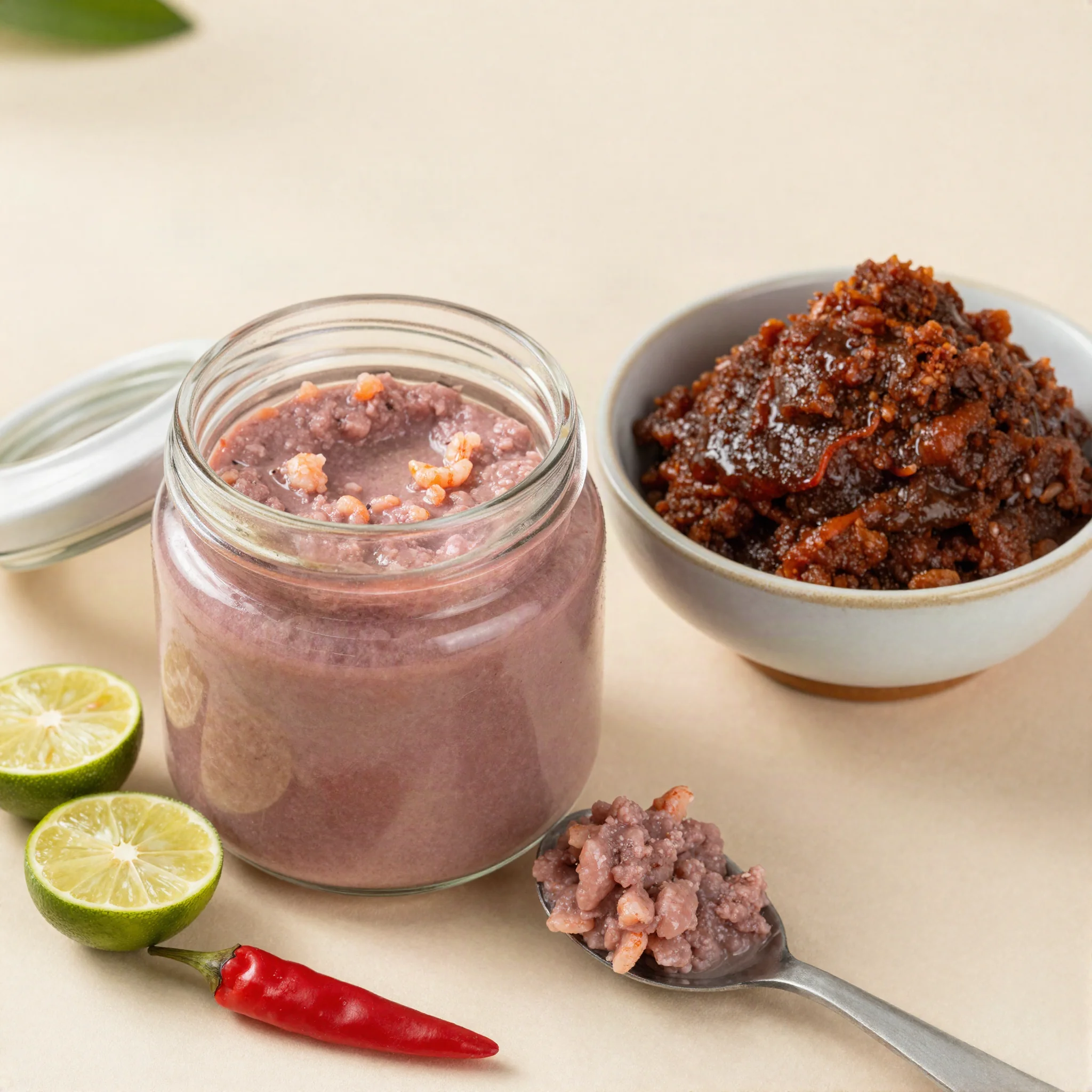
Bagoong
Bagoong (Philippine fermented fish or krill/shrimp paste)
Condiment/paste
Facts
| Category | Meat / Fish |
|---|---|
| Product family | Philippine Bagoong |
| Origin | 🇵🇭 Philippines |
| Key microorganisms | halophilic-other |
Safety
- Salt concentration is the primary preservation control and under-salting is the central failure mode: salt is the only barrier across a months-long ambient ferment of raw marine protein. Documented risk factors:
(a) Histamine and other biogenic amines — the defining hazard of fermented fish, and elevated for bagoong isda specifically because anchovy-type fish are histidine-rich scombroid-family fish. Bacteria decarboxylate histidine to histamine during fermentation and storage; histamine is heat-stable and NOT destroyed by cooking, so sautéing bagoong does not remove it. Control is upstream only: genuinely fresh fish, salted promptly, never temperature-abused.
(b) Clostridium botulinum type E — fish-associated and cold-tolerant, able to grow at refrigeration temperatures other types cannot, in exactly the sealed anaerobic salted mass this product creates. Adequate salt is the hurdle; an under-salted sealed vat removes it.
(c) CRUSTACEAN / SHELLFISH ALLERGEN — bagoong alamang. The krill/shrimp form is a crustacean product and a severe allergen risk. It matters disproportionately because bagoong is used invisibly inside cooked dishes (stews, vegetable dishes, dipping sauces) where a shellfish-allergic person may not know it is present. Always declare it. Bagoong isda is a fish product and carries the fish allergen instead — the two forms are not interchangeable for an allergic person, and "bagoong" alone does not tell you which.
(d) Parasites — raw marine fish and crustaceans carry parasite risk; salting and fermentation are not validated kill steps, and the product is conventionally cooked.
(e) Listeria monocytogenes and Salmonella — handling hazards of raw seafood and of a ready-to-use condiment: clean equipment and hands, no cross-contamination between raw material and finished paste, covered storage.
(f) Spoilage/putrefaction — an under-salted or air-exposed batch putrefies rather than ferments; gas, slime, discoloration or off-odour beyond the normal pungency means discard. Safe-practice guidance: use genuinely fresh fish or krill and salt promptly; hold the traditional high salt proportion throughout; keep solids submerged under the expressed liquid and the vessel covered; declare the crustacean or fish allergen whenever the paste is used for others; discard spoiled batches. Do not reduce the salt to make it milder. Numerics: no salt percentage, histamine ppm, pH value, temperature or duration is asserted — (illustrative) / not established.
Method
Bagoong (Philippine fermented fish or krill/shrimp paste)
- Either small marine fish, anchovy-type (bagoong isda) or krill / very small shrimp (alamang, for bagoong alamang) — one or the other, not mixed — ~3 kg (illustrative)
- Salt — SAFETY CONTROL — ~1 kg (illustrative; the family convention is 3 parts fish to 1 part salt by weight — the direction matters, it is three times as much fish as salt). This proportion is the sole preservation control across the whole ferment and must not be reduced for palatability.
- Clean vat, crock or jar with a cover and a weight
- (no starter culture — this ferment is spontaneous)
- Allergen note: the krill/shrimp version is a crustacean product and the fish version is a fish product. They are not interchangeable for anyone avoiding either.
- 1
Step 1
Use freshly landed fish or krill. Rinse and drain; do not gut small fish or peel the krill — the viscera and whole bodies carry the endogenous proteolytic enzymes that drive the conversion.
- 2
Step 2
Mix thoroughly with the salt until every part of the mass is evenly salted — even distribution is itself a control point.
- 3
Step 3
Pack tightly into the vat or jar, excluding air.
- 4
Step 4
Weight the mass so the liquid that forms rises above the solids — the high-salt liquid is the protective environment (SAFETY CONTROL, see linked Variant). Cover.
- 5
Step 5
Fermentation stage: hold at ambient temperature for an extended period. The mass darkens/reddens and develops its characteristic aroma as endogenous enzymes and halophilic flora convert the protein. (Temperature and duration: not established.)
- 6
Step 6
Check periodically that the solids remain submerged and show no spoilage signs; re-cover after inspection.
- 7
Step 7
Draw off the clear liquid that separates — this is patis (Philippine fish sauce), the sibling product, which has its own entry and its own safety statement.
- 8
Step 8
Pack the remaining solid paste into clean covered containers as bagoong.
- 9
Step 9
Use as a condiment (with green mango), cooked into dishes such as pinakbet, or sautéed with aromatics as ginisang bagoong. Declare the crustacean or fish allergen when serving others.
Frequently asked questions
- What is Bagoong?
- Condiment/paste
- Which microorganisms ferment Bagoong?
- Bagoong is primarily driven by halophilic-other.
- Where does Bagoong come from?
- Bagoong is traditionally made in Philippines.
- Is Bagoong safe to make at home?
- Salt concentration is the primary preservation control and under-salting is the central failure mode: salt is the only barrier across a months-long ambient ferment of raw marine protein. Documented risk factors:
(a) Histamine and other biogenic amines — the defining hazard of fermented fish, and elevated for bagoong isda specifically because anchovy-type fish are histidine-rich scombroid-family fish. Bacteria decarboxylate histidine to histamine during fermentation and storage; histamine is heat-stable and NOT destroyed by cooking, so sautéing bagoong does not remove it. Control is upstream only: genuinely fresh fish, salted promptly, never temperature-abused.
(b) Clostridium botulinum type E — fish-associated and cold-tolerant, able to grow at refrigeration temperatures other types cannot, in exactly the sealed anaerobic salted mass this product creates. Adequate salt is the hurdle; an under-salted sealed vat removes it.
(c) CRUSTACEAN / SHELLFISH ALLERGEN — bagoong alamang. The krill/shrimp form is a crustacean product and a severe allergen risk. It matters disproportionately because bagoong is used invisibly inside cooked dishes (stews, vegetable dishes, dipping sauces) where a shellfish-allergic person may not know it is present. Always declare it. Bagoong isda is a fish product and carries the fish allergen instead — the two forms are not interchangeable for an allergic person, and "bagoong" alone does not tell you which.
(d) Parasites — raw marine fish and crustaceans carry parasite risk; salting and fermentation are not validated kill steps, and the product is conventionally cooked.
(e) Listeria monocytogenes and Salmonella — handling hazards of raw seafood and of a ready-to-use condiment: clean equipment and hands, no cross-contamination between raw material and finished paste, covered storage.
(f) Spoilage/putrefaction — an under-salted or air-exposed batch putrefies rather than ferments; gas, slime, discoloration or off-odour beyond the normal pungency means discard. Safe-practice guidance: use genuinely fresh fish or krill and salt promptly; hold the traditional high salt proportion throughout; keep solids submerged under the expressed liquid and the vessel covered; declare the crustacean or fish allergen whenever the paste is used for others; discard spoiled batches. Do not reduce the salt to make it milder. Numerics: no salt percentage, histamine ppm, pH value, temperature or duration is asserted — (illustrative) / not established.
Community results
No community results published for this ferment yet.