
Dairy
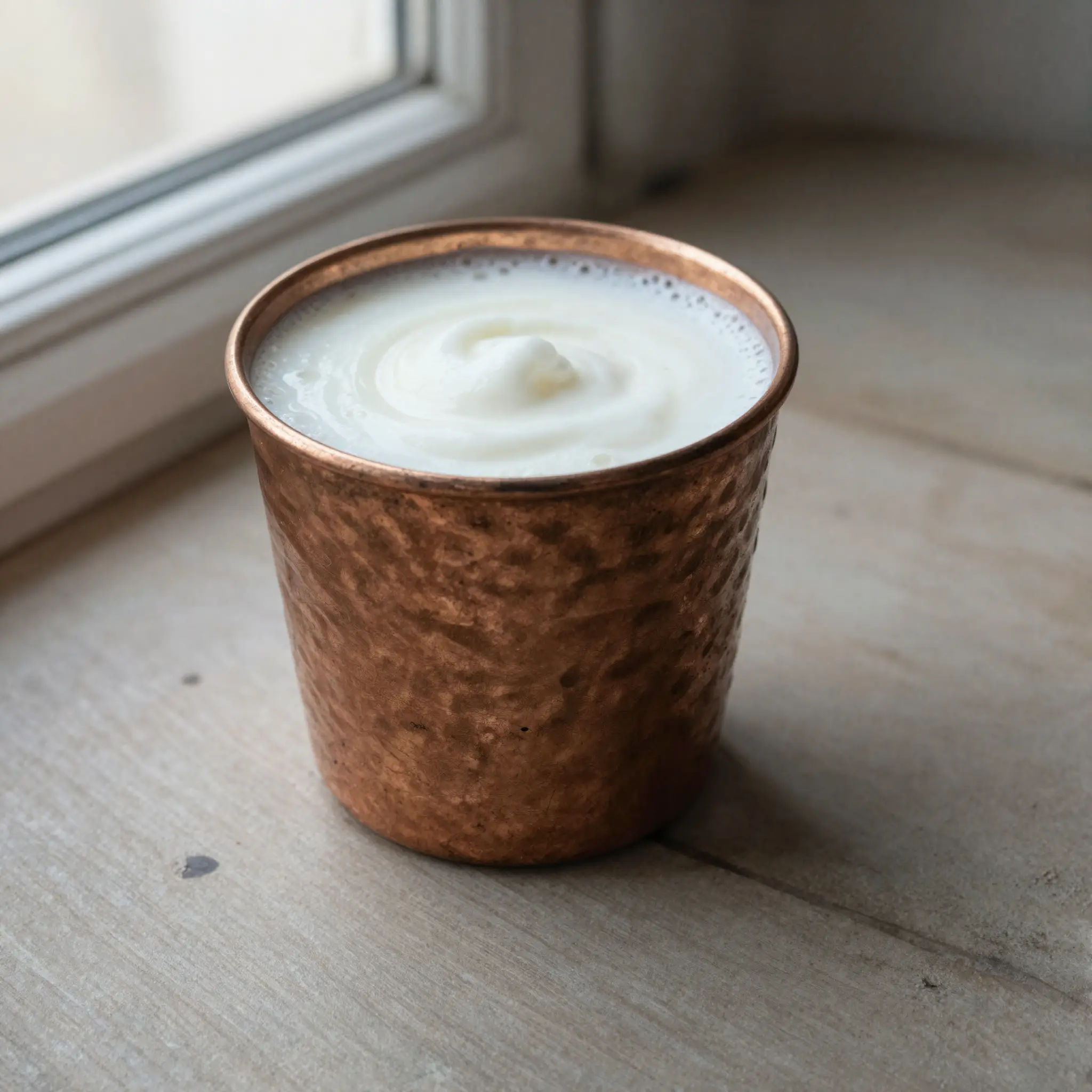
Ayran (Turkish diluted salted yogurt drink)
Dairy beverage
Facts
| Category | Dairy |
|---|---|
| Product family | Fermented Yogurt-Beverage |
| Origin | 🇹🇷 Türkiye |
| Key microorganisms | lactic-acid-bacteria |
Safety
- No significant additional risk factors beyond those already documented for the base fermented-yogurt product it is made from — ayran itself introduces no new fermentation step, only dilution and salting. Documented risk factor (inherited from yogurt/dairy-beverage handling generally): dilution with water introduces a food-safety-relevant variable — the water used must be potable, and diluted, salted yogurt is a lower-acid, higher-moisture product than the parent set yogurt, so it is more perishable once diluted and should not be treated as shelf-stable at ambient temperature. Safe-practice guidance:
(a) use pasteurized milk for the base yogurt, for the same raw-milk pathogen reasons documented for base yogurt;
(b) dilute with clean potable water;
(c) refrigerate diluted ayran promptly and consume within a short window (a few days, illustrative) rather than storing it at the longer timescale appropriate to the un-diluted set yogurt;
(d) commercial shelf-stable ayran typically relies on pasteurization/UHT processing after culturing, which is a distinct industrial safety model from the fresh, live-culture home preparation described here — the two should not be conflated.
Method
Ayran (Turkish Diluted Salted Yogurt Drink)
- Finished, live-culture plain yogurt (cow's, or traditionally sheep's/goat's) — ~500 g
- Cold water — quantity to reach a thin, pourable consistency (commonly cited home ratio of roughly 1 part yogurt to 1–3 parts water, illustrative — a matter of taste, not a safety parameter)
- Salt — to taste (a few pinches per serving, illustrative) — flavour, non-safety
- Optional: a few fresh mint leaves, chilled to serve (flavour only, non-safety)
- 1
Step 1
Start with finished, live-culture yogurt that has already completed its own lactic fermentation (see linked Variant item 7 for the base-yogurt culturing step, inherited, not repeated here).
- 2
Step 2
Place the yogurt in a pitcher or blender.
- 3
Step 3
Add cold water gradually, whisking or blending until smooth and uniformly thin.
- 4
Step 4
Add salt to taste; stir or blend to dissolve fully.
- 5
Step 5
Chill thoroughly.
- 6
Step 6
Whisk or shake again just before serving to restore a light foam on top, if separation has occurred.
- 7
Step 7
Serve cold, optionally garnished with mint.
Frequently asked questions
- What is Ayran (Turkish diluted salted yogurt drink)?
- Dairy beverage
- Which microorganisms ferment Ayran (Turkish diluted salted yogurt drink)?
- Ayran (Turkish diluted salted yogurt drink) is primarily driven by lactic-acid-bacteria.
- Where does Ayran (Turkish diluted salted yogurt drink) come from?
- Ayran (Turkish diluted salted yogurt drink) is traditionally made in Türkiye.
- Is Ayran (Turkish diluted salted yogurt drink) safe to make at home?
- No significant additional risk factors beyond those already documented for the base fermented-yogurt product it is made from — ayran itself introduces no new fermentation step, only dilution and salting. Documented risk factor (inherited from yogurt/dairy-beverage handling generally): dilution with water introduces a food-safety-relevant variable — the water used must be potable, and diluted, salted yogurt is a lower-acid, higher-moisture product than the parent set yogurt, so it is more perishable once diluted and should not be treated as shelf-stable at ambient temperature. Safe-practice guidance:
(a) use pasteurized milk for the base yogurt, for the same raw-milk pathogen reasons documented for base yogurt;
(b) dilute with clean potable water;
(c) refrigerate diluted ayran promptly and consume within a short window (a few days, illustrative) rather than storing it at the longer timescale appropriate to the un-diluted set yogurt;
(d) commercial shelf-stable ayran typically relies on pasteurization/UHT processing after culturing, which is a distinct industrial safety model from the fresh, live-culture home preparation described here — the two should not be conflated.
Community results
No community results published for this ferment yet.