
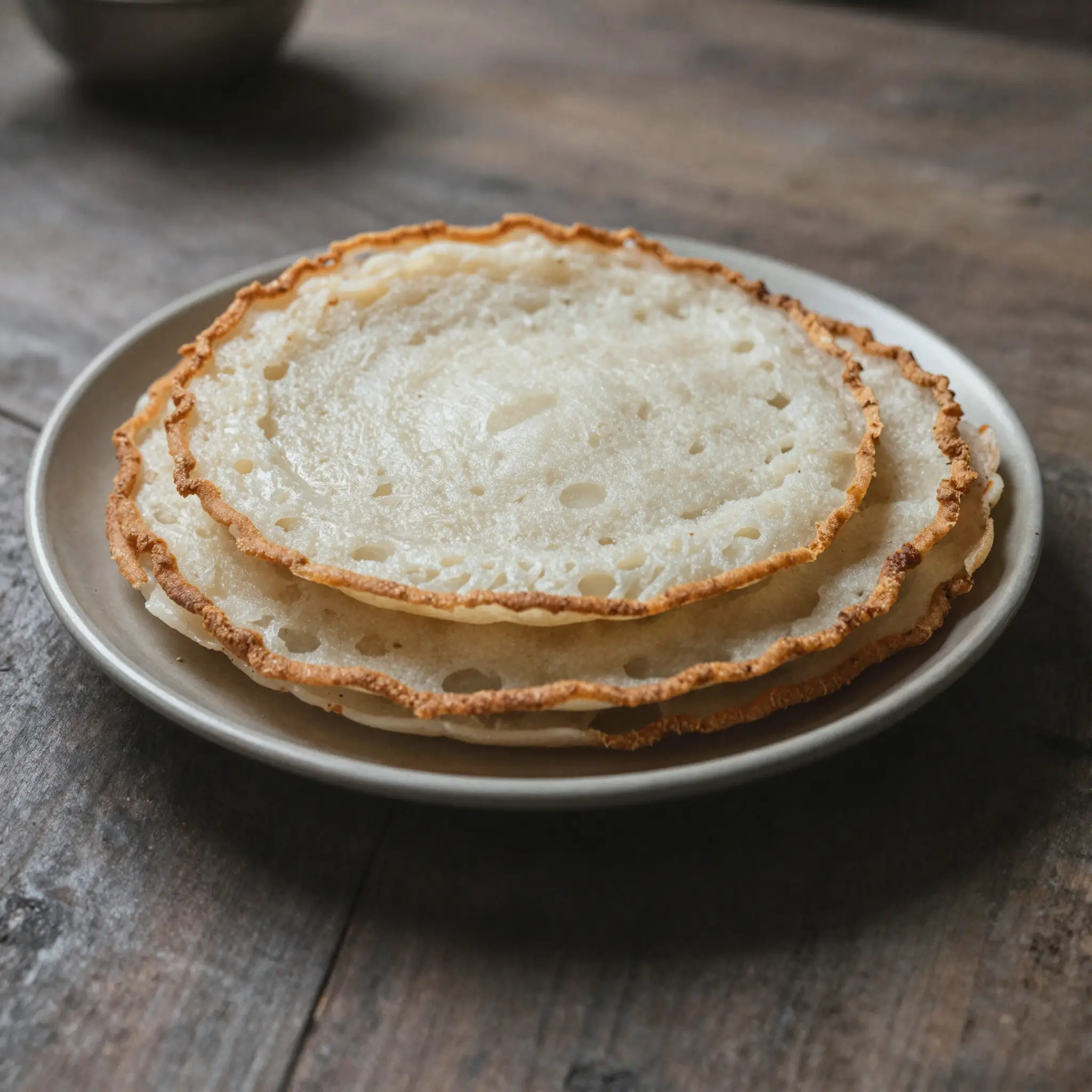
Appam (South Indian/Sri Lankan fermented rice-and-coconut batter bowl-shaped pancake)
Bread/staple
Facts
| Category | Grain / Legume |
|---|---|
| Product family | Fermented Rice-Batter Staple |
| Origin | 🇮🇳 India |
| Key microorganisms | lactic-acid-bacteria, yeasts |
Safety
- Documented considerations (honest, grain-staple-appropriate, general-knowledge basis — flagged):
(a) appam batter is a spontaneous or toddy-/yeast-aided fermentation with no formally defined starter culture in most traditional practice, so adequate acidification and visible fermentation activity (a risen, bubbly, pleasantly sour-and-sweet-smelling batter) are the primary indicators of a safely proceeding ferment;
(b) mould growth or a markedly putrid/off odour signals spoilage rather than successful fermentation — such batter should be discarded, not consumed;
(c) griddling/cooking after fermentation is itself a safety-relevant cooking step, fully heat-treating the batter;
(d) rice substrates carry a general, honestly-disclosed cereal mould/mycotoxin awareness applicable to any stored rice or rice flour — use fresh, properly stored, non-mouldy rice, and discard any batter made from visibly spoiled raw ingredients (no specific mycotoxin threshold is asserted);
(e) coconut milk/grated coconut, being a perishable dairy-like-fat ingredient, should be fresh and properly stored before incorporation into the batter, and the finished batter/cooked appam should not be left at unsafe ambient temperature for extended periods once coconut is added (a general perishable-ingredient hygiene note, not a quantified regulatory claim);
(f) potable water must be used throughout soaking, grinding, and batter preparation. Safe-practice guidance: use clean equipment and potable water; use fresh coconut/coconut milk and refrigerate the batter if not used promptly once coconut is added; ferment in a warm ambient location, loosely covered; confirm visible rise/aeration and a pleasant sour aroma before cooking; discard on mould growth or a clearly putrid off-odour; cook thoroughly on the griddle/pan until set. No specific pH, temperature, duration, or mycotoxin-threshold figures are asserted — any such figure is illustrative or not established.
Method
Appam (South Indian/Sri Lankan Fermented Rice-and-Coconut Batter Bowl-Shaped Pancake)
- Rice (raw or par-boiled), soaked, plus a small portion of cooked rice — ~1.5 cups raw-equivalent (illustrative)
- Grated fresh coconut or coconut milk — ~1 cup (illustrative)
- Water — for soaking, grinding, and thinning, potable
- Traditional leavening aid: a small quantity of toddy (fermented palm/coconut sap); modern substitute: a pinch of yeast, baking soda, or sugar (household-variable, non-safety choice)
- Salt — to taste, non-safety
- To serve: coconut milk, vegetable stew (ishtu), or curry — serving custom, not part of the ferment
- 1
Step 1
Soak the rice in potable water for several hours.
- 2
Step 2
Grind the soaked rice with the portion of cooked rice and grated coconut/coconut milk into a smooth, pourable batter, adding potable water as needed.
- 3
Step 3
Stir in the toddy (or modern substitute leavening aid) and salt.
- 4
Step 4
Transfer to a clean, non-reactive vessel and cover loosely (not airtight).
- 5
Step 5
Leave to ferment spontaneously (or toddy-/yeast-aided) at warm ambient temperature.
- 6
Step 6
Check periodically: the batter should visibly rise/bubble with a pleasant sour-and-sweet aroma.
- 7
Step 7
Continue fermenting to the desired rise and sourness (typically several hours up to overnight, illustrative, tradition- and household-variable, general-knowledge).
- 8
Step 8
Ladle a portion of the fermented batter into a small, curved, lidded appachatti/appam pan and swirl to coat the sides.
- 9
Step 9
Cover and cook over medium heat until the centre is set and the edges are thin, lacy, and crisp.
- 10
Step 10
Serve warm with coconut milk, vegetable stew, or curry (serving custom, not part of the ferment).
Frequently asked questions
- What is Appam (South Indian/Sri Lankan fermented rice-and-coconut batter bowl-shaped pancake)?
- Bread/staple
- Which microorganisms ferment Appam (South Indian/Sri Lankan fermented rice-and-coconut batter bowl-shaped pancake)?
- Appam (South Indian/Sri Lankan fermented rice-and-coconut batter bowl-shaped pancake) is primarily driven by lactic-acid-bacteria, yeasts.
- Where does Appam (South Indian/Sri Lankan fermented rice-and-coconut batter bowl-shaped pancake) come from?
- Appam (South Indian/Sri Lankan fermented rice-and-coconut batter bowl-shaped pancake) is traditionally made in India.
- Is Appam (South Indian/Sri Lankan fermented rice-and-coconut batter bowl-shaped pancake) safe to make at home?
- Documented considerations (honest, grain-staple-appropriate, general-knowledge basis — flagged):
(a) appam batter is a spontaneous or toddy-/yeast-aided fermentation with no formally defined starter culture in most traditional practice, so adequate acidification and visible fermentation activity (a risen, bubbly, pleasantly sour-and-sweet-smelling batter) are the primary indicators of a safely proceeding ferment;
(b) mould growth or a markedly putrid/off odour signals spoilage rather than successful fermentation — such batter should be discarded, not consumed;
(c) griddling/cooking after fermentation is itself a safety-relevant cooking step, fully heat-treating the batter;
(d) rice substrates carry a general, honestly-disclosed cereal mould/mycotoxin awareness applicable to any stored rice or rice flour — use fresh, properly stored, non-mouldy rice, and discard any batter made from visibly spoiled raw ingredients (no specific mycotoxin threshold is asserted);
(e) coconut milk/grated coconut, being a perishable dairy-like-fat ingredient, should be fresh and properly stored before incorporation into the batter, and the finished batter/cooked appam should not be left at unsafe ambient temperature for extended periods once coconut is added (a general perishable-ingredient hygiene note, not a quantified regulatory claim);
(f) potable water must be used throughout soaking, grinding, and batter preparation. Safe-practice guidance: use clean equipment and potable water; use fresh coconut/coconut milk and refrigerate the batter if not used promptly once coconut is added; ferment in a warm ambient location, loosely covered; confirm visible rise/aeration and a pleasant sour aroma before cooking; discard on mould growth or a clearly putrid off-odour; cook thoroughly on the griddle/pan until set. No specific pH, temperature, duration, or mycotoxin-threshold figures are asserted — any such figure is illustrative or not established.
Community results
No community results published for this ferment yet.